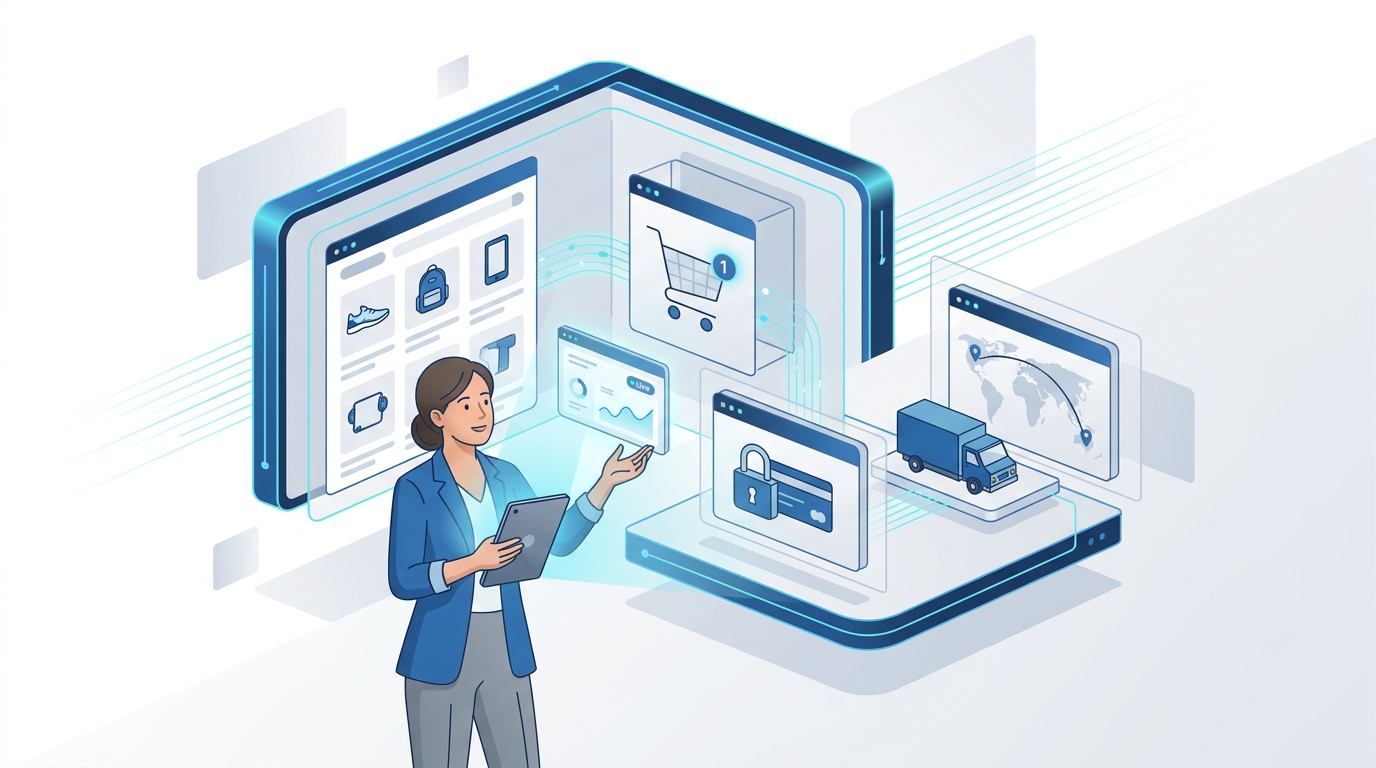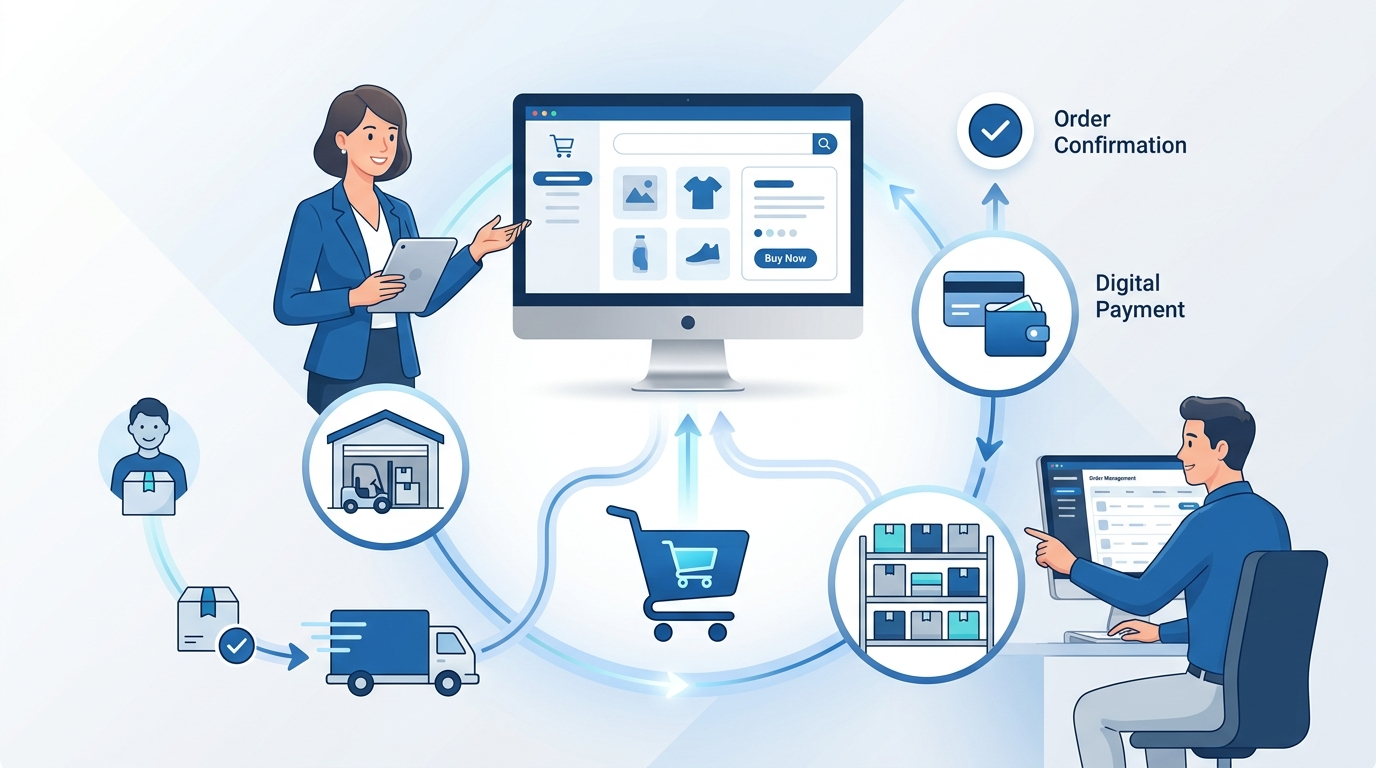
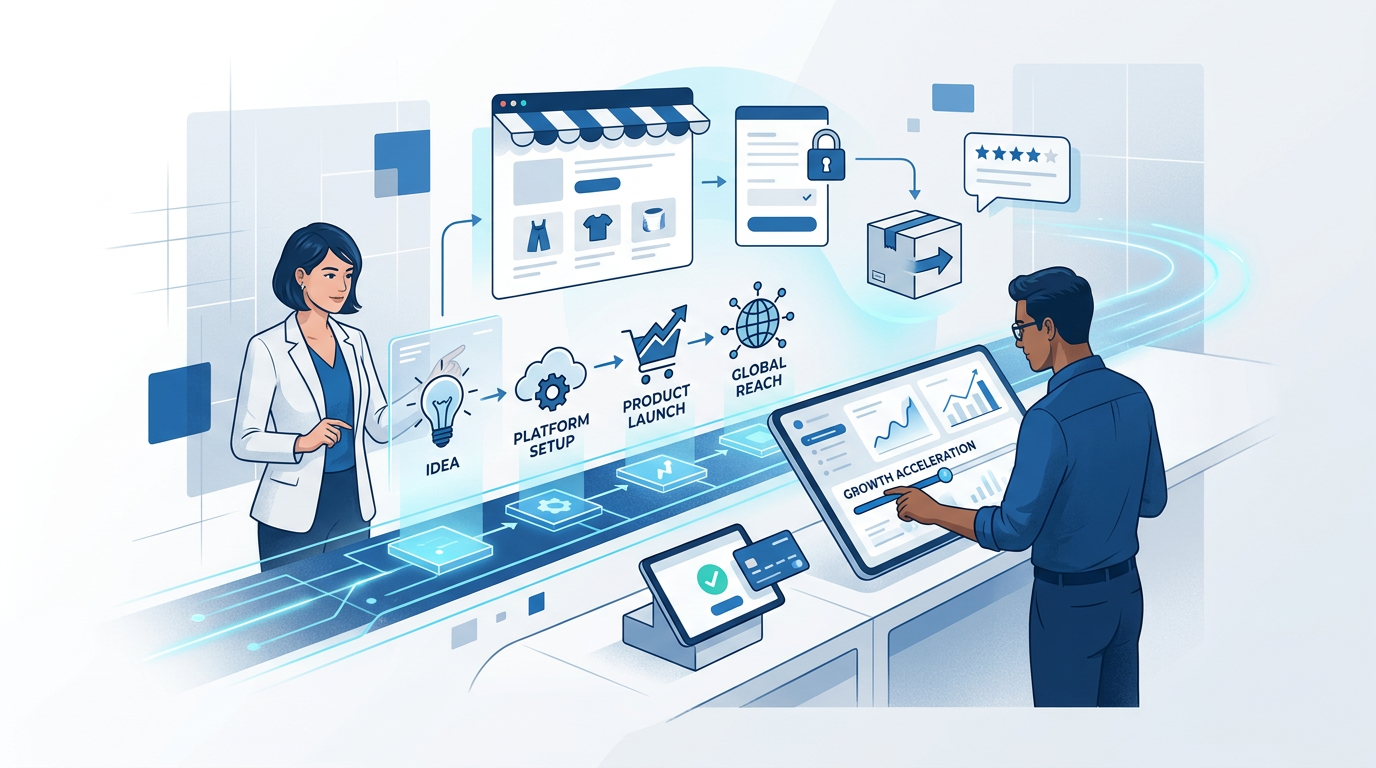
To start an ecommerce business, validate a specific customer problem, choose a workable product and business model, calculate unit economics, register the business, secure suppliers, select a sales platform, build payment and fulfillment processes, test the full order journey and launch with a controlled marketing budget. A store should prove demand and delivery reliability before scaling traffic.
Most startup guides begin with choosing a platform or designing a logo. That order is convenient but commercially weak. Software can create a storefront in hours, yet software cannot prove that customers want the product, that the margin survives returns or that suppliers can fulfill the promise.
The safer approach is to build a minimum viable commerce system. The system must prove six things before expansion: customer demand, product margin, supply reliability, payment completion, delivery performance and customer support. A polished website without those proofs is an unfinished business.
For a clear definition of digital ordering and what qualifies as an online transaction, review our guide to e-commerce basics.
What Is an Ecommerce Business?
An ecommerce business receives orders through digital systems designed for buying or selling goods or services. The business may sell physical products, digital products, subscriptions, services or access. Payment and delivery can occur online or offline; the defining feature is that the order is placed through a digital ordering method.
An ecommerce business is not limited to a standalone website. Orders may come through a mobile app, online marketplace, social commerce interface, business procurement system or connected retail platform. The channel is only one part of the operating model.
Before You Start: The Six Proofs of a Viable Store
| Proof | Question to Answer | Minimum Evidence |
|---|---|---|
| Demand | Will a defined customer pay for this offer? | Interviews, pre-orders, test sales or measurable purchase intent |
| Margin | Does the order produce contribution after variable costs? | Costed order model including returns and acquisition |
| Supply | Can products be obtained at the promised quality and timing? | Samples, lead times, backup options and written terms |
| Payment | Can customers pay reliably and securely? | Successful test transactions, refunds and fraud controls |
| Fulfillment | Can the order be picked, packed, shipped and tracked? | End-to-end test orders with measured cost and delivery time |
| Support | Can the business resolve questions, cancellations and returns? | Published policies, support ownership and exception procedures |
A founder does not need perfect evidence before launch. The goal is to replace assumptions with enough direct evidence to limit avoidable loss.
How to Start an Ecommerce Business in 12 Steps
Step 1: Choose a Customer Problem, Not a Random Product
Action: Define one customer group, one purchase situation and one problem the offer will solve. A useful problem statement describes the trigger, current alternative, important constraint and desired outcome.
Reason: Product lists are easy to copy. Customer understanding is harder to copy and improves product selection, messaging, pricing and service.
Expected result: A sentence such as: “Remote workers in small apartments need a compact desk setup that can be stored quickly without looking temporary.”
Warning sign: The idea depends on “everyone” as the audience or on a product being popular without explaining why a specific customer would choose this store.
Step 2: Validate Demand Before Building the Store
Action: Interview potential customers, review direct and indirect competitors, inspect search behavior, test a simple landing page or offer a small batch. Ask what customers currently buy, why they switch and what prevents purchase.
Reason: Market research reduces the risk of investing in a product that receives attention but not purchases. Competitor analysis also reveals price ranges, service expectations and entry barriers.
Expected result: Evidence that customers recognize the problem, understand the offer and accept a realistic price range.
Warning sign: People praise the idea but avoid a deposit, order, waitlist commitment or specific purchase question.
Step 3: Select the Business Model
Action: Decide who owns inventory, who fulfills orders and how revenue is earned. Common options include inventory-led retail, direct-to-consumer, dropshipping, marketplace selling, subscriptions, digital products and made-to-order production.
Reason: The model determines working capital, control, margin, delivery risk and customer ownership. A low-inventory model may reduce startup cost while increasing supplier dependence.
Expected result: A written flow showing supplier, seller, customer, payment, inventory and delivery responsibilities.
Warning sign: The business cannot explain who handles a damaged item, delayed shipment, refund or chargeback.
Our detailed comparison of each business model explains how inventory ownership and revenue streams change operating risk.
Step 4: Calculate Unit Economics and Startup Costs
Action: Build a cost model for one normal order. Include product cost, inbound freight, packaging, payment fees, shipping subsidy, marketplace fees, expected returns, customer support and customer acquisition.
Reason: Gross margin alone can hide an unprofitable order. A product may appear profitable before marketing and fulfillment but lose money after the full customer journey.
Expected result: A contribution estimate and maximum affordable acquisition cost.
Warning sign: The plan uses revenue or markup as profit and excludes refunds, failed deliveries, discounts or damaged stock.
| Illustrative $80 Order | Amount |
|---|---|
| Net selling price | $80 |
| Product and inbound cost | -$31 |
| Payment and platform fees | -$4 |
| Packaging and fulfillment | -$7 |
| Shipping subsidy | -$8 |
| Expected returns and support | -$5 |
| Contribution before acquisition | $25 |
In this example, customer acquisition must remain below $25 for the first order to produce positive contribution. A lower limit may be necessary when the business also needs to cover fixed costs and cash reserves.
Step 5: Write a Lean Business Plan
Action: Document the customer, problem, offer, competitors, model, channel, suppliers, operating process, startup budget, revenue assumptions and major risks. Keep the first version concise enough to update.
Reason: A business plan forces assumptions into visible statements. It also helps founders identify dependencies before spending money.
Expected result: A working plan with monthly cash needs, launch milestones and measurable stop-or-continue conditions.
Warning sign: The financial forecast grows every month without explaining inventory, traffic, conversion, returns or staffing.
Step 6: Choose the Legal Structure and Register the Business
Action: Choose a legal structure, register the business name where required, obtain tax identifiers, review licenses and open a separate business bank account. Requirements depend on the owner’s location, customer markets, product type and operating structure.
Reason: Business structure can affect liability, taxation, fundraising and filing obligations. Registration and permit rules vary significantly by jurisdiction.
Expected result: A legally recognized business with documented ownership, tax treatment and financial separation.
Warning sign: The founder copies a legal structure from another country or assumes online selling removes local registration, product or tax obligations.
Step 7: Secure Products and Suppliers
Action: Request samples, verify specifications, compare lead times, define minimum order quantities and document quality, packaging, replacement and refund terms. Test at least one backup option for a critical product.
Reason: Supplier failures become customer-facing failures. A low unit price is not valuable when the supplier ships late, changes materials or provides inaccurate stock information.
Expected result: Approved samples, landed cost, reorder point, lead-time range and an exception process.
Warning sign: The forecast uses the supplier’s best possible lead time and assumes every received unit will be sellable.
Step 8: Choose the Sales Platform and Technology
Action: Compare platforms by catalog needs, checkout, payment support, taxes, shipping, integrations, ownership, security, ongoing cost and migration options. Choose the smallest system that reliably supports the operating model.
Reason: The best ecommerce platform for small business is not universally the platform with the most features. Excess complexity increases setup time, maintenance and dependency.
Expected result: A platform decision tied to required workflows rather than a feature checklist.
Warning sign: The store buys expensive software before confirming product structure, order volume or integration needs.
| Requirement | Question to Test |
|---|---|
| Catalog | Can the system handle variants, bundles and required attributes? |
| Checkout | Does it support target devices, markets and payment methods? |
| Operations | Can staff process orders, refunds and inventory adjustments? |
| Integration | Does it connect to accounting, shipping and customer service? |
| Ownership | Can product, customer and order data be exported? |
| Cost | What are the subscription, transaction, app and development costs? |
Step 9: Build the Offer and Store Content
Action: Create product information that answers purchase questions: use, specifications, size, materials, compatibility, price, delivery, returns and support. Design a clear offer that may include bundles, guarantees or service without relying entirely on discounts.
Reason: Customers cannot inspect an online product in the same way they inspect a store item. Accurate content reduces uncertainty, support demand and avoidable returns.
Expected result: Each product page lets a qualified customer decide whether the product fits the intended use.
Warning sign: Product descriptions repeat supplier marketing language but omit dimensions, limitations, delivery or return conditions.
Step 10: Set Up Payments, Security and Policies
Action: Use reputable payment providers, minimize direct handling of payment data, control staff access, maintain software updates and test refunds. Publish privacy, shipping, return, contact and terms information appropriate to the business.
Reason: Payment security depends on people, processes and technology. Outsourcing checkout can reduce technical exposure, but the merchant still needs to manage accounts, access, vendors and website security.
Expected result: Successful test payments and refunds, documented access ownership and customer-facing policies that match actual operations.
Warning sign: Shared administrator passwords, unnecessary plugins, unverified payment scripts or a return policy the support team cannot apply.
Step 11: Build Fulfillment and Customer Service
Action: Document order release, picking, packing, tracking, cancellation, failed delivery, return and refund steps. Assign an owner for every exception and measure actual handling time.
Reason: Customers judge the entire order, not only the website. Fulfillment and service failures can make successful marketing unprofitable.
Expected result: A repeatable order process with known costs, deadlines and escalation paths.
Warning sign: The founder knows the normal process but cannot explain what happens when an item is missing, damaged or delivered late.
Step 12: Test, Launch and Learn in Controlled Stages
Action: Place test orders on mobile and desktop, use different payment and delivery scenarios, complete a cancellation and refund, then launch to a limited audience. Track contribution, conversion, delivery, returns and support.
Reason: A controlled launch exposes failures while order volume remains manageable. Large advertising campaigns amplify both strengths and weaknesses.
Expected result: A list of verified workflows, measured baseline performance and a clear decision about what to improve before scaling.
Warning sign: The launch plan focuses on visitors and revenue but has no maximum loss, inventory limit or operational stop condition.
A 30-Day Lean Launch Plan
| Period | Primary Work | Evidence Required |
|---|---|---|
| Days 1–7 | Customer interviews, competitor review and offer definition | Recognized problem, price range and objection list |
| Days 8–14 | Supplier samples, cost model and business setup | Landed cost, lead time, contribution and legal checklist |
| Days 15–21 | Store, payments, policies and fulfillment workflow | Complete test orders, refunds and operational procedures |
| Days 22–30 | Limited launch, customer feedback and failure correction | Real orders, delivery data, support issues and revised economics |
The schedule is not suitable for every product. Custom manufacturing, regulated goods and complex B2B sales require more time. The value of the framework is sequencing: evidence before scale and operations before aggressive acquisition.
How Much Does It Cost to Start?
There is no universal startup budget. A digital product can begin with limited inventory expense, while a private-label physical product may require samples, tooling, certifications, minimum orders, storage and freight.
Separate costs into three groups:
- One-time setup: registration, design, samples, photography, equipment and initial development.
- Recurring fixed costs: platform subscriptions, accounting, insurance, software and storage.
- Variable order costs: product, packaging, payment, fulfillment, shipping, returns and acquisition.
Funding for ecommerce business growth should match the cash cycle. Inventory businesses often pay suppliers before receiving customer cash and may wait through delivery and return periods before the profit is certain. Financing does not repair negative unit economics; it only allows the business to operate the same economics at a larger scale.
How to Create the First Marketing Plan
A new store should choose channels according to how customers discover and evaluate the product. Search can capture existing demand. Social and creator content can demonstrate unfamiliar products. Email can support abandoned carts and repeat purchases after consent.
Start with one acquisition channel, one owned retention channel and one measurement process. Set a test budget and define the result that justifies continued spending.
Our guide to building a practical marketing plan explains channel roles, contribution-based targets and why attributed revenue is not always incremental revenue.
Where AI Helps a New Ecommerce Business
AI can assist with product attribute cleanup, support-ticket classification, search, draft content and demand analysis. A small business should use AI to support a defined workflow rather than automate high-impact decisions immediately.
Generated product information must be checked against approved supplier data. Automated support should escalate unusual refunds, payment disputes and safety questions. Our guide to AI tools covers practical use cases, measurement and failure controls.
Common Ecommerce Startup Failures
| Failure | Warning Sign | Consequence | Prevention |
|---|---|---|---|
| Building before validating | Months of design with no customer commitments | Capital is spent before demand is proven | Run interviews, samples and small sales first |
| Choosing products only by trend | The offer has no defined customer advantage | Price competition and unstable demand | Connect product selection to a specific problem |
| Ignoring full order cost | Revenue grows while cash becomes tighter | Each order may destroy contribution | Include acquisition, fulfillment, returns and support |
| Depending on one supplier | One delay stops all fulfillment | Cancellations and reputation damage | Approve alternatives and maintain safety stock where practical |
| Launching too many products | Incomplete pages and slow stock turnover | Working capital and attention become fragmented | Begin with a narrow, coherent assortment |
| Using policies copied from another store | Published promises conflict with real operations | Disputes, complaints and inconsistent decisions | Write policies from actual processes and local obligations |
| Scaling ads before operations | Support backlog and late orders rise with traffic | Marketing amplifies service failures | Set operational thresholds before increasing spend |
| Buying excessive technology | Software cost grows before order volume | Complexity delays learning and launch | Buy capabilities only when a defined process requires them |
Pre-Launch Readiness Checklist
- The target customer and purchase problem are specific.
- At least one form of real demand evidence exists.
- The business model and party responsibilities are documented.
- Contribution is calculated after expected variable costs.
- Supplier samples and lead times are verified.
- Registration, tax, license and product requirements are reviewed locally.
- Payment, cancellation and refund tests are complete.
- Inventory and fulfillment responsibilities are assigned.
- Policies match the process the business can deliver.
- Launch budget, maximum acceptable loss and stop conditions are defined.
Frequently Asked Questions
How do I start an ecommerce business with no experience?
Start with a narrow customer problem and a small test rather than a large catalog. Learn demand validation, unit economics, supplier management, payments and fulfillment in sequence. Use established service providers for complex infrastructure, but keep ownership of product data, customer promises and financial decisions.
How much money is needed to start an ecommerce business?
The required amount depends on inventory, product development, registration, platform, marketing and fulfillment. Digital products may need little inventory capital, while private-label goods may require substantial upfront cash. Calculate one-time, fixed and variable costs, then add a reserve for delays, returns and failed tests.
Can I start a small ecommerce business from home?
A home-based ecommerce business may be possible when local rules, lease conditions, insurance, product safety and storage needs permit it. The owner should separate business finances, confirm shipping and return capacity and avoid keeping inventory that creates safety, access or zoning problems.
What products are best for a new ecommerce business?
The best starting products solve a clear problem, have reliable supply, understandable differentiation, manageable return risk and enough contribution after delivery and acquisition. A product with strong demand can still be unsuitable when it is fragile, regulated, seasonal or expensive to return.
Do I need an ecommerce website to begin?
A standalone website is not always required for initial validation. A founder can test through a marketplace, landing page, social channel or manual order process. A dedicated store becomes more useful when the business needs stronger brand control, customer data, merchandising, integrations and owned customer relationships.
How long does it take to start an ecommerce business?
A simple digital or resale offer can launch in weeks, while manufacturing, regulated products and complex integrations can require months. Speed should be measured by completed evidence and reliable processes, not by how quickly a template is published.
Is dropshipping the easiest way to start?
Dropshipping reduces the need to buy inventory before sale, but it transfers control to suppliers. The seller still handles customer expectations, refunds, chargebacks and reputation. Dropshipping is easier to start technically, but it is not automatically easier to operate profitably.
When should a new store scale?
A new store should scale after it demonstrates repeatable demand, positive or strategically acceptable contribution, reliable supply, controlled delivery performance and manageable support. Increasing traffic before these conditions are stable usually magnifies existing failures.
Final Summary
Learning how to start an ecommerce business is mainly about sequencing decisions correctly. Validate the customer problem before selecting technology, calculate full order economics before buying inventory and test fulfillment before increasing marketing.
A reliable launch proves six capabilities: demand, margin, supply, payment, fulfillment and support. The website connects these capabilities, but the website is not a substitute for them.
Start with a narrow offer, document responsibilities, run complete test orders and launch to a controlled audience. Expand only after real customer behavior and operating data confirm that the business can keep its promise without losing control of cash or service quality.