
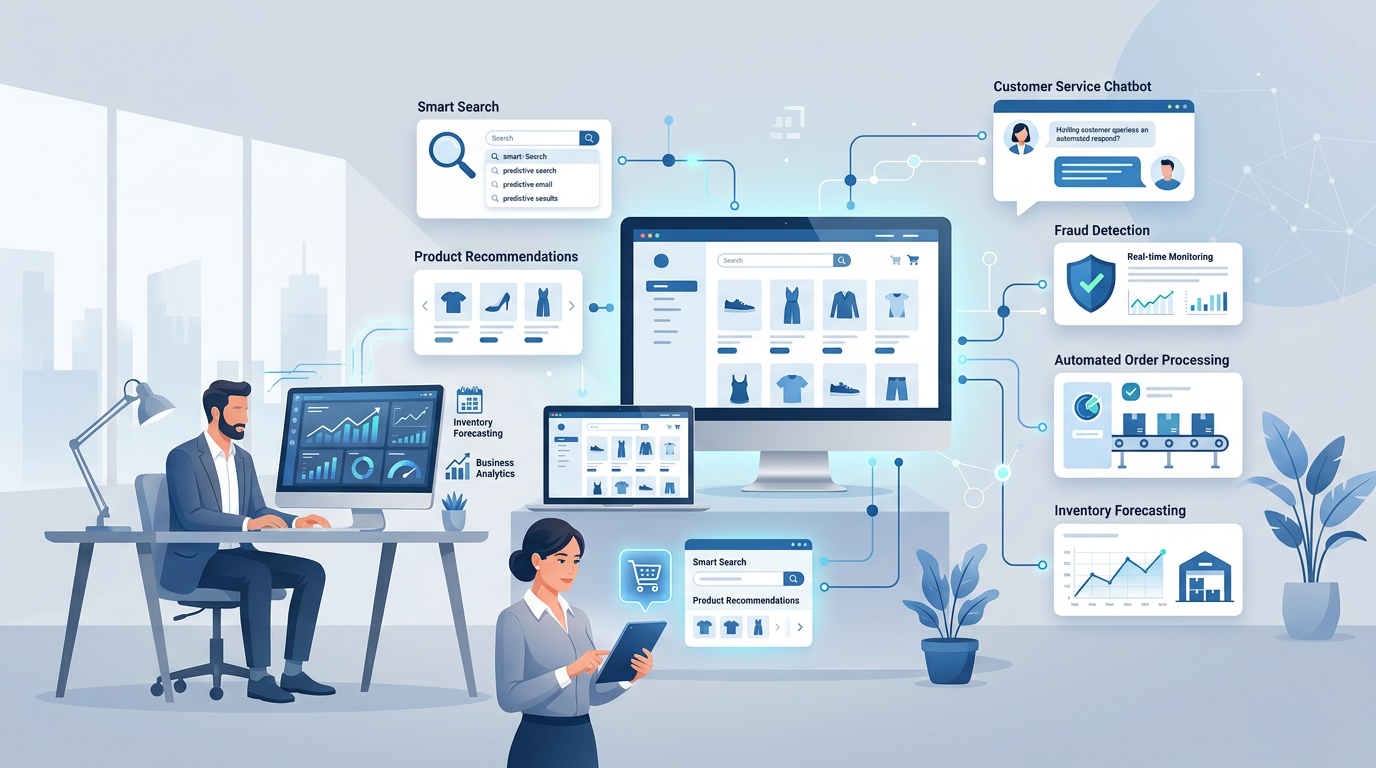
AI in e-commerce uses machine learning, language models, computer vision and predictive analytics to improve product discovery, customer service, fraud control, forecasting and routine operations. The technology creates the most value when it solves a defined business problem, uses reliable data and keeps human review for decisions that affect customers, prices, payments or inventory.
Artificial intelligence is becoming a normal business tool rather than an experimental feature. In 2025, about one in five firms across reporting OECD countries used AI, more than double the share recorded in 2023. European data showed a similar pattern, but adoption remained uneven: roughly 20% of enterprises used AI in 2025, compared with more than half of large enterprises.
The adoption gap matters for online retailers. Large marketplaces can train systems on enormous volumes of searches, clicks, purchases and returns. Smaller stores usually have less data, fewer specialists and narrower budgets. A small merchant should therefore avoid copying enterprise AI projects and instead choose focused applications with measurable operational value.
Readers who need a foundation can review e-commerce basics before examining how intelligent systems fit into the transaction process.
What Does AI Mean in E-Commerce?
AI in e-commerce refers to software that identifies patterns, generates content, predicts outcomes or recommends actions using business and customer data. The system may rank products, classify support tickets, forecast demand, detect suspicious transactions, produce draft descriptions or suggest the next best action for an employee.
AI does not represent one product or one level of capability. A rules-based chatbot, a recommendation model and a generative assistant solve different problems. An online retailer should evaluate each use case separately instead of treating “AI” as a single platform decision.
| AI Method | Typical E-Commerce Use | Required Input | Main Limitation |
|---|---|---|---|
| Predictive machine learning | Demand forecasts, churn scores and fraud detection | Historical labeled data | Performance can decline when customer behavior changes |
| Recommendation systems | Product ranking, bundles and related-item suggestions | Catalog, interaction and transaction data | Can overpromote popular products and reduce variety |
| Natural language processing | Search understanding, review analysis and ticket routing | Customer queries and text records | Language, context and ambiguity can reduce accuracy |
| Generative AI | Draft content, summaries and service responses | Prompts, approved knowledge and business context | Can invent facts or produce inconsistent answers |
| Computer vision | Visual search, image tagging and damage detection | Product and operational images | Results depend on image quality and training coverage |
Where AI Creates Real Business Value
The strongest AI projects improve a measurable process rather than adding a visible feature for marketing purposes. Useful targets include lower service time, better search relevance, fewer stockouts, reduced manual catalog work, higher fraud detection precision or more accurate demand forecasts.
Product Discovery and Search
Traditional site search often depends on exact keywords. An intelligent search system can interpret spelling errors, synonyms, attributes and natural-language questions. A shopper searching for “light waterproof jacket for spring travel” may receive relevant products even when the catalog does not contain that exact phrase.
Search quality depends on catalog structure. AI cannot reliably match products when titles are vague, attributes are missing or variants are inconsistent. Before adding semantic search, a retailer should standardize categories, sizes, colors, materials, compatibility fields and availability data.
Product Recommendations
AI product recommendations rank items according to customer behavior, product similarity, context or predicted purchase probability. Recommendations may appear on homepages, product pages, carts, email campaigns and post-purchase messages.
Recommendation systems should optimize for more than clicks. A model that repeatedly promotes high-click products may increase engagement while reducing margin, inventory balance or customer satisfaction. Better objectives can include contribution margin, availability, return risk, variety and long-term customer value.
Personalization
E-commerce personalization changes content, ranking, offers or communication according to a customer’s context and behavior. Useful signals may include location, device, referral source, browsing history, purchase history, stated preferences and loyalty status.
Personalization becomes harmful when the business cannot explain why customers see different experiences or when the system uses sensitive or unreliable signals. Personalization should reduce search effort and improve relevance, not manipulate customers or hide important choices.
Customer Service
AI customer service can classify tickets, retrieve approved information, summarize conversations, suggest replies and answer routine questions. These tools can shorten handling time for delivery updates, return instructions, product compatibility and account questions.
A customer-facing assistant should know when to stop. Payment disputes, unusual return situations, legal complaints, accessibility needs and emotionally charged cases often require a trained employee. A reliable escalation path is more valuable than a chatbot that attempts to answer every question.
Catalog and Content Operations
Generative tools can draft product descriptions, normalize attributes, translate text, create image tags and identify missing catalog fields. The main operational benefit is speed, especially when a retailer manages thousands of products from multiple suppliers.
Generated catalog content still requires validation. A model may invent specifications, misuse technical terms or create claims that suppliers cannot support. The safest workflow separates source data from generated wording and blocks publication when required attributes are missing.
Demand Forecasting and Inventory
AI inventory management uses historical sales, seasonality, promotions, lead times and external signals to estimate future demand. Forecasts can support reorder timing, allocation, safety stock and markdown planning.
Forecasting systems fail when historical data no longer represents current conditions. A viral post, supplier delay, competitor promotion or sudden weather event can make recent patterns unreliable. Merchandisers should monitor forecast error and retain manual override controls for unusual events.
Fraud and Payment Risk
AI fraud detection evaluates transaction patterns, device signals, account behavior and historical outcomes to estimate risk. The system can help prioritize manual reviews and identify combinations that simple rules might miss.
Fraud prevention involves a tradeoff. Aggressive blocking may reduce fraudulent orders but reject legitimate customers. A useful fraud model should track false declines, review workload, chargebacks and customer impact rather than reporting only the number of blocked transactions.
Pricing and Promotion
AI can estimate price sensitivity, recommend markdowns and evaluate promotional scenarios. Retailers can use these tools to manage inventory and test how price changes affect demand.
Personalized pricing carries greater legal, ethical and reputational risk than personalized product ranking. Businesses should distinguish between segment-level promotion planning and individualized price decisions. Any automated pricing process needs documented limits, competition review and clear consumer protections.
Automation vs Personalization
E-commerce automation and personalization are related but different. Automation reduces manual work by triggering a process. Personalization changes an experience for a particular customer or context. A system can automate a standard shipping update without personalization, while a recommendation model can personalize product ranking without fully automating the final decision.
| Criterion | Automation | Personalization |
|---|---|---|
| Primary goal | Reduce repetitive work and process delay | Improve relevance for a customer or situation |
| Typical example | Route a return request to the correct queue | Rank products according to customer intent |
| Main metric | Time saved, error rate and process cost | Conversion, engagement, satisfaction and customer value |
| Main risk | Automating a broken process | Using inappropriate data or creating unfair treatment |
| Human role | Handle exceptions and improve workflow rules | Set boundaries, review outcomes and protect customer choice |
How to Choose the Right AI Use Case
The best first project is usually a frequent, measurable and reversible process. A retailer should not begin with a high-risk decision simply because the technology is available.
Step 1: Define the Business Problem
State the problem in operational terms. “Use generative AI” is not a business problem. “Reduce the average time required to classify and route support tickets from six minutes to two minutes” is measurable and testable.
Step 2: Establish the Baseline
Record the current cost, error rate, completion time and customer outcome before introducing the system. Without a baseline, the business cannot determine whether the tool improved the process or simply changed it.
Step 3: Audit the Data
Identify the data required, its owner, retention rules, quality problems and permitted uses. Product recommendation systems need dependable catalog and behavior data. Service assistants need an approved knowledge base. Forecasting models need consistent sales, inventory and promotion history.
Step 4: Assess the Consequence of Error
Different mistakes create different damage. A poor product tag may be corrected quickly. A false fraud decision may block a customer. An invented safety specification may create serious liability. Higher-consequence applications require stricter validation and human oversight.
Step 5: Run a Controlled Pilot
Limit the first deployment by category, market, customer group or employee team. Compare results with the existing process. The pilot should include ordinary cases, edge cases and failure tests rather than only successful demonstrations.
Step 6: Measure the Whole Outcome
Measure business value and side effects. A support assistant may reduce handling time but increase repeat contacts. A recommendation model may lift average order value but also increase returns. A fraud system may stop chargebacks while creating costly false declines.
Step 7: Create a Review and Shutdown Process
Assign an owner, review schedule and rollback method. Models can deteriorate when products, prices, customer behavior or data sources change. A retailer should be able to pause the system without stopping essential operations.
AI Use-Case Priority Matrix
| Use Case | Potential Value | Error Consequence | Suitable First Project? |
|---|---|---|---|
| Ticket classification | Medium to high | Low when employees review routing | Yes |
| Draft product descriptions | Medium | Medium because facts can be invented | Yes, with source validation |
| Search query understanding | High | Low to medium | Yes, with relevance testing |
| Demand forecasting | High | Medium to high | Yes, with manual overrides |
| Product recommendations | High | Medium | Yes, after catalog cleanup |
| Automatic refund approval | Medium | High | Only after a limited pilot |
| Individualized pricing | Uncertain | High legal and reputational risk | No for most small stores |
Practical Example: A Mid-Sized Home Goods Store
Consider an online store with 12,000 products, seasonal demand and a support team that receives 1,500 tickets per week. The store wants to use AI but has limited engineering capacity.
Phase 1: Improve Data Quality
The store standardizes product types, dimensions, materials, colors and compatibility fields. The team removes duplicate records and creates an approved service knowledge base. This work is not visually impressive, but it determines whether later systems can produce reliable results.
Phase 2: Add Assisted Automation
An AI tool classifies support tickets and drafts responses using the approved knowledge base. Employees review every response before sending it. The business measures handling time, correction rate, repeat contacts and escalation volume.
Phase 3: Improve Product Discovery
The store introduces semantic search for natural-language queries and tests recommendation blocks on selected categories. The test compares search success, product-page visits, conversion, margin and returns against the previous experience.
Phase 4: Support Inventory Decisions
A forecasting model suggests reorder quantities for stable categories. Buyers keep approval authority and record why they override the recommendation. These notes help identify missing variables, such as supplier delays, planned promotions or regional events.
The sequence reduces risk because every phase builds on better data and controlled human review. The store does not begin with autonomous pricing or fully automated refunds. The business starts where errors are observable and reversible.
Common AI Failures in Online Retail
| Failure | Warning Sign | Business Impact | Prevention |
|---|---|---|---|
| Automating poor data | Different systems show conflicting product attributes | Incorrect recommendations, search results and content | Clean and govern source data before deployment |
| Hallucinated product information | Generated descriptions contain unsupported specifications | Returns, complaints and possible liability | Generate only from approved fields and require validation |
| Recommendation feedback loops | The same popular items dominate every placement | Reduced discovery and overdependence on a narrow catalog | Add diversity, freshness and inventory constraints |
| Hidden false declines | Fraud losses fall while checkout complaints rise | Legitimate revenue and customer trust are lost | Measure false positives and provide review paths |
| Uncontrolled customer-service answers | Chat responses conflict with store policy | Escalations, refunds and reputational damage | Use retrieval from approved content and confidence thresholds |
| Model drift | Accuracy declines after catalog or market changes | Gradual performance loss that dashboards may miss | Monitor outcomes and schedule revalidation |
| Vendor lock-in | The store cannot export prompts, logs or model outputs | High switching cost and weak auditability | Define portability and data ownership before purchase |
| Automation without accountability | No employee owns the final customer outcome | Errors remain unresolved and responsibility becomes unclear | Assign process owners and escalation authority |
Privacy, Fairness and AI Governance
AI governance is the set of responsibilities, controls and records used to manage an intelligent system throughout its lifecycle. Governance should begin before procurement, not after a problem appears.
A practical structure follows four actions: govern the system, map its context, measure performance and manage identified risks. This approach is consistent with widely used AI risk-management guidance and works for both purchased tools and internally developed models.
- Govern: assign ownership, approval authority, policies and documentation requirements.
- Map: identify users, affected customers, data sources, intended uses and foreseeable misuse.
- Measure: test accuracy, bias, security, privacy, robustness and customer impact.
- Manage: prioritize risks, introduce controls, monitor results and stop unsafe uses.
Retailers should collect only the data required for the defined purpose. Customer data should not automatically become training data. Contracts should explain whether vendors retain prompts, use merchant data to improve shared models, permit deletion and support audit logs.
Human review is not a universal solution. A reviewer who approves hundreds of recommendations without adequate context provides little protection. Effective oversight gives the reviewer enough information, time and authority to change the outcome.
How to Measure AI Performance
AI measurement should combine model quality with business and customer outcomes. A model can achieve high technical accuracy while producing little commercial value.
| Application | Model Metric | Business Metric | Customer Metric |
|---|---|---|---|
| Search | Relevance and zero-result rate | Conversion and margin per search | Time to find a suitable product |
| Recommendations | Precision, diversity and coverage | Incremental revenue and return-adjusted margin | Relevance and choice quality |
| Customer service | Answer accuracy and escalation accuracy | Handling time and repeat-contact cost | Resolution and satisfaction |
| Forecasting | Forecast error | Stockouts, overstock and working capital | Product availability |
| Fraud detection | Precision and recall | Chargebacks and review cost | False decline rate |
A retailer should compare AI-assisted performance with the previous process or a control group. Platform claims and demonstrations do not establish value for a specific catalog, customer base or operating model.
What Most Businesses Get Wrong About AI
The most common mistake is treating AI adoption as a software purchase. The difficult work usually involves process design, data quality, evaluation, employee training and exception handling. A powerful model connected to an unclear process can accelerate errors rather than improve results.
A second mistake is pursuing complete autonomy. Partial automation often creates more value with less risk. A system that prepares a reliable recommendation for an employee can save time while preserving judgment for unusual cases.
A third mistake is measuring only immediate revenue. Personalization can increase conversion while narrowing customer choice, increasing returns or promoting low-margin products. The correct evaluation includes net revenue, contribution, customer outcomes and operational side effects.
Frequently Asked Questions
How is AI used in e-commerce?
AI is used in e-commerce for search, recommendations, personalization, customer service, content operations, demand forecasting, inventory planning, fraud detection and pricing analysis. The strongest application depends on the retailer’s data quality, business model, customer risk and ability to measure results.
What is e-commerce automation?
E-commerce automation uses software to complete or route repetitive tasks with limited manual effort. AI-based automation can classify requests, predict outcomes or generate drafts, while traditional automation follows fixed rules. Human review remains important when errors affect payments, refunds, inventory or customer rights.
How does AI personalization work?
AI personalization analyzes customer, product and contextual signals to rank content or recommend actions. A personalization system may adjust search results, product recommendations or messages. Reliable personalization requires transparent objectives, appropriate data use, performance testing and safeguards against bias or excessive manipulation.
Can small online stores use AI?
Small online stores can use AI effectively when they choose narrow, measurable applications such as ticket classification, catalog cleanup, draft content or search improvement. Small retailers should avoid complex autonomous systems until data quality, governance, testing and human oversight are established.
What are the risks of AI in online retail?
The main risks include inaccurate outputs, privacy violations, biased decisions, false fraud declines, poor recommendations, vendor dependence, security exposure and weak accountability. Risk increases when the system makes high-impact decisions without reliable data, monitoring, documentation or a human escalation path.
Will AI replace e-commerce employees?
AI is more likely to change tasks than eliminate every role. Intelligent tools can reduce repetitive classification, drafting and analysis, while employees remain responsible for exceptions, customer judgment, strategy, supplier coordination and accountability. The workforce impact depends on how the business redesigns processes and training.
What is the best first AI project for an e-commerce business?
The best first AI project is frequent, measurable, low-risk and reversible. Ticket classification, catalog enrichment and assisted search are often suitable because employees can review results. Automated pricing, refunds and high-impact fraud decisions require stronger controls and should not be the first experiment.
Final Summary
AI can improve online retail when it is connected to a specific process, reliable data and measurable outcomes. Useful applications include product discovery, recommendations, service support, catalog operations, demand forecasting, inventory planning and fraud analysis.
The safest adoption path begins with low-risk assistance rather than full autonomy. Retailers should establish a baseline, audit data, test a limited deployment, measure business and customer outcomes, document responsibility and maintain a shutdown process.
AI does not replace the commercial fundamentals described in a sound marketing strategy. Product value, accurate information, reliable fulfillment and customer trust still determine whether technology produces sustainable growth.