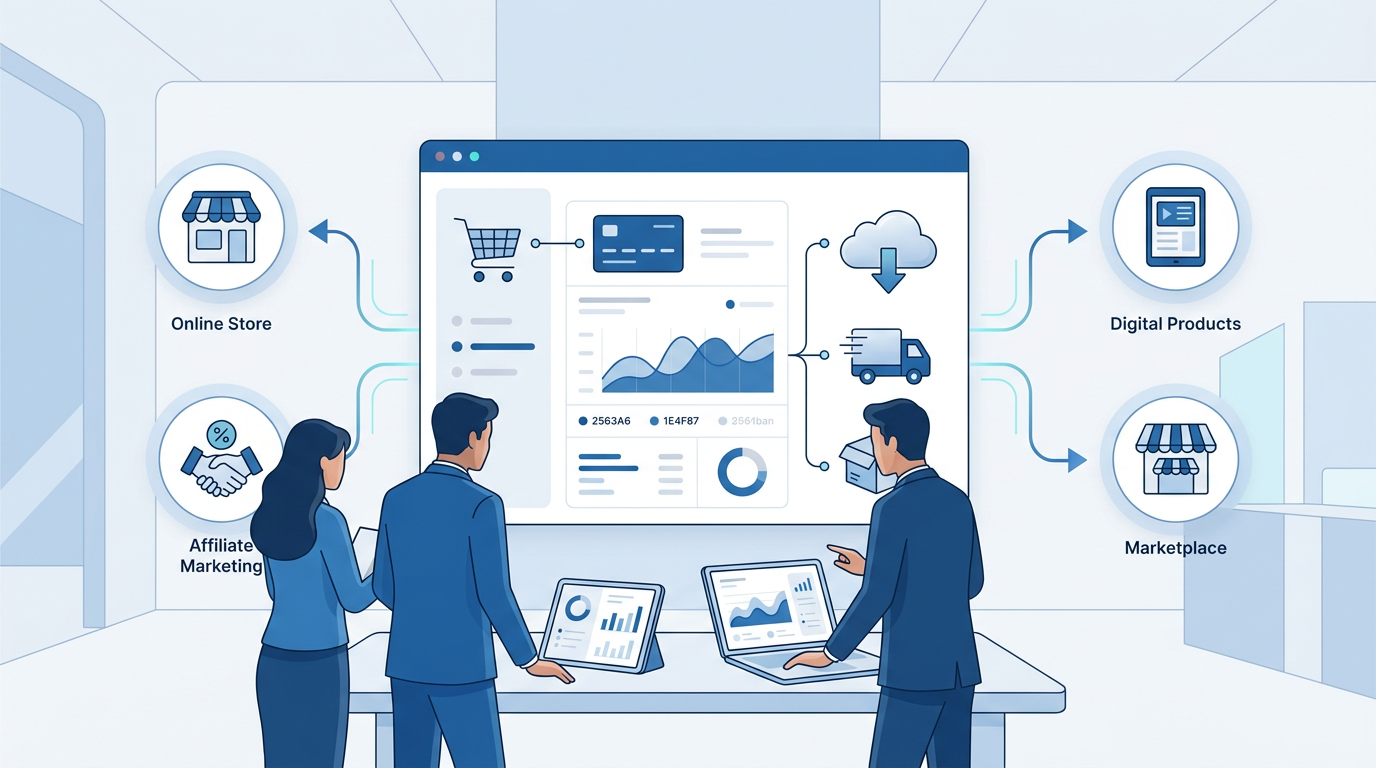
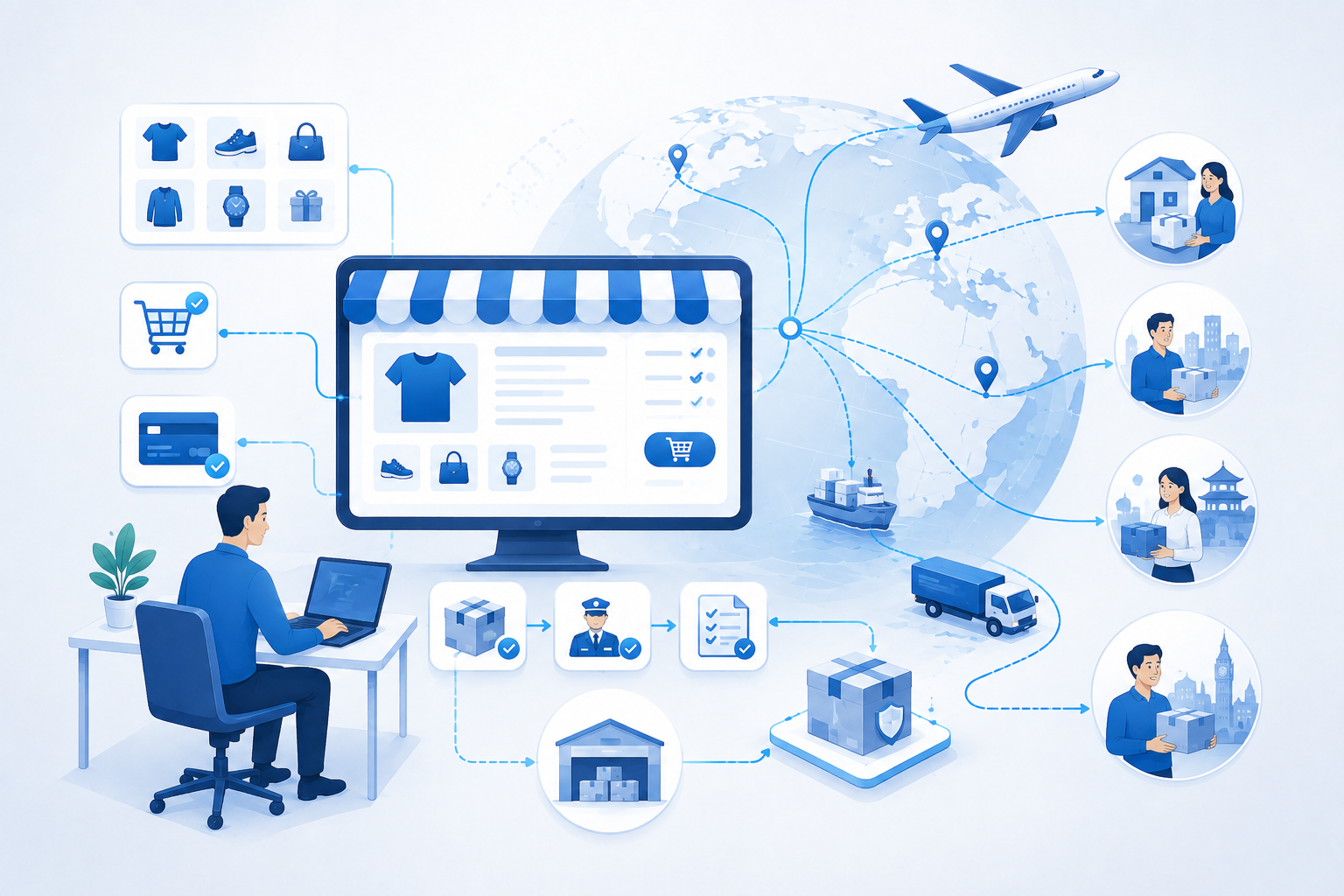
Cross border e commerce is the online sale of goods or services where the buyer and seller are located in different countries. It works by connecting digital product discovery and checkout with international payment, tax, customs, fulfillment, delivery, returns and customer-service processes. A sale is commercially viable only when the final landed economics and legal responsibilities are understood before the order is accepted.
A website can make a product visible worldwide in minutes, but visibility is not the same as market access. The seller still needs to determine whether the product may be imported, how taxes and duties will be handled, which payment methods customers trust, how long delivery takes and what happens when an order is refused or returned.
The strongest international expansion plans begin with a narrow market, a controlled product range and a complete order test. They do not begin by turning on worldwide shipping for an entire catalog.
Readers who need the underlying transaction definition can review e-commerce basics.
What Is Cross Border E Commerce?
Cross-border e-commerce is a digitally ordered transaction between a customer and a seller in different economic territories. The product may be shipped physically, delivered digitally or fulfilled through a partner located closer to the buyer.
The transaction can be:
- business-to-consumer, such as a customer ordering clothing from a foreign retailer;
- business-to-business, such as a company buying components through an online portal;
- consumer-to-consumer through an international marketplace;
- digitally delivered, such as software, media, research or online services.
The defining feature is not the website language or payment currency. It is that the commercial transaction crosses a national border and therefore introduces additional rules, costs and operational handoffs.
Cross-Border, International and Global E-Commerce
| Term | Practical Meaning | Example |
|---|---|---|
| Domestic e-commerce | Buyer and seller operate within the same country | A local store ships to another city |
| Cross-border e-commerce | An individual online order crosses a national border | A customer imports a product from a foreign seller |
| International e commerce | A business operates digital sales in two or more countries | A retailer localizes checkout for several markets |
| Global e-commerce | A coordinated multi-market model with shared technology and local execution | A brand manages regional pricing, fulfillment and service |
Global cross border e commerce is therefore not simply a large number of exports. It is an operating model that coordinates products, pricing, compliance, payments, data, logistics and customer experience across several markets.
Why Businesses Sell Across Borders
International online selling can expand the reachable market without requiring a full physical retail network in every country. A company may also use cross-border demand to extend the life of specialized products, reach diaspora communities, serve underserved niches or reduce dependence on one domestic market.
UNCTAD reported that business e-commerce sales across 43 countries, representing roughly three-quarters of global GDP, grew nearly 60% between 2016 and 2022. The data cover domestic and international transactions, but they show why businesses increasingly treat digital ordering as part of trade strategy rather than a separate marketing experiment.
Potential benefits include:
- access to customers with limited local product choice;
- new revenue from existing products and content;
- market testing before physical expansion;
- greater geographic diversification;
- direct demand data from international customers;
- use of marketplaces and logistics partners as export infrastructure.
The opportunity must be evaluated after duties, tax, payment, delivery, returns and support. International revenue can grow while contribution per order falls.
The Three Flows Behind Every International Order
A useful cross-border model separates three flows: goods or services, information and money. The World Bank uses this distinction when explaining trade and logistics for e-commerce.
| Flow | What Moves | Main Failure Risk |
|---|---|---|
| Goods or services | Product, parcel, digital access or service output | Delay, damage, restriction or failed delivery |
| Information | Product data, order details, customs data and tracking | Incorrect classification, address or document |
| Money | Customer payment, tax, duty, fees, settlement and refund | Decline, unexpected charge, FX loss or reconciliation gap |
A cross-border order fails when any one flow breaks. A parcel may reach the destination while customs information is incomplete. A payment may settle while the product is prohibited. A refund may be approved while foreign-exchange differences create a customer dispute.
How Cross-Border E-Commerce Works
1. The Customer Discovers the Offer
The buyer finds the product through search, advertising, social media, a marketplace or an existing brand relationship. The product page should state where the seller is located and whether the offer is available in the customer’s market.
2. The Store Localizes the Buying Decision
Localization can include language, currency display, measurement units, product specifications, compatibility, delivery estimates and return conditions. Translation alone does not make an offer locally suitable.
3. Checkout Calculates the Commercial Terms
The checkout confirms product price, shipping, tax, duty treatment, payment method and total amount. The customer should understand whether import charges are prepaid or may be collected at delivery.
4. Payment Is Authorized and Settled
The payment provider evaluates the transaction, converts currency where required and sends settlement to the merchant. The order system needs to preserve the relationship between the customer amount, merchant amount, exchange rate, fees and refund rules.
5. The Order Receives Trade Data
Physical goods require accurate product description, value, origin and tariff classification. The carrier, postal operator, customs broker or platform may use this data to prepare declarations and clear the shipment.
6. The Product Is Fulfilled
The order may ship from the seller’s country, a regional warehouse, a marketplace fulfillment network or a local distributor. The model changes delivery time, inventory ownership and tax exposure.
7. Delivery and Customer Service Complete the Promise
The customer receives tracking and delivery information. Failed delivery, damage, refusal and returns need defined ownership across the seller, carrier, platform and local service provider.
The Eight-Gate Market Entry Test
Before enabling a country, a seller should pass eight gates.
| Gate | Question | Evidence Required |
|---|---|---|
| Demand | Is there identifiable customer demand? | Search, marketplace, enquiry or test-order data |
| Product admissibility | Can the product be legally imported and sold? | Restriction, safety, labeling and licensing review |
| Landed economics | Does the order remain profitable after full costs? | Product, shipping, tax, duty, return and acquisition model |
| Payment fit | Can customers pay using trusted local methods? | Authorization, fraud and settlement testing |
| Logistics | Can delivery meet the promise consistently? | Carrier service, tracking and failed-delivery data |
| Tax and customs | Who calculates, collects, reports and pays? | Market-specific professional review |
| Service and returns | Can problems be solved at reasonable cost? | Return route, support hours and refund workflow |
| Technology and data | Can systems preserve correct market-level records? | Checkout, order, inventory and finance tests |
A market should not launch because it passes only the demand gate. Strong demand can magnify compliance, delivery and return failures.
Choosing the First International Market
The best first market is not automatically the largest. A nearby country with familiar language, similar regulation and predictable logistics may produce better learning at lower risk.
A practical scorecard can rate each market from 1 to 5.
| Factor | Low Score | High Score |
|---|---|---|
| Demand evidence | General interest only | Existing enquiries or test orders |
| Product fit | Restrictions or incompatible standards | Clear admissibility and local relevance |
| Delivery | Slow, expensive or weak tracking | Predictable service and return route |
| Payments | Low authorization or unfamiliar methods | Trusted methods and stable settlement |
| Language and service | High localization burden | Existing team can support customers |
| Economics | Low contribution after landed costs | Healthy contribution and repeat potential |
The score should guide investigation rather than replace it. A high score does not remove the need for product, tax and legal review.
Sales Channels for International E-Commerce
Own Online Store
An owned storefront gives the seller more control over brand, customer data, product presentation and checkout. The business also carries more responsibility for traffic, localization, compliance, payment, delivery and support.
Marketplace
A marketplace may provide demand, local payment options, trust, fulfillment services and seller tools. It can also charge commissions, control customer communication and impose account or product rules.
Distributor or Local Retail Partner
A local partner can import inventory and manage domestic sales. This reduces some direct operational complexity but also reduces control and margin.
Hybrid Model
A business may use a marketplace to validate demand, then add an owned store or local inventory after the market is proven. The right structure depends on inventory ownership, customer relationship and responsibility for the transaction. Our guide to business models explains these tradeoffs.
How to Compare the Top Global Marketplaces for E-Commerce
The phrase top global marketplaces for e-commerce should not be treated as one universal ranking. Marketplace strength varies by country, product category, buyer type and seller eligibility.
Well-known examples include Amazon, eBay, Alibaba and AliExpress, Etsy, Mercado Libre, Rakuten and Shopee. Availability, services and seller requirements can change by market.
| Comparison Factor | Why It Matters |
|---|---|
| Market and category reach | A large platform may have weak demand for the specific product |
| Seller eligibility | Business location, tax and product rules may limit access |
| Total fees | Commission, advertising, fulfillment and currency costs affect margin |
| Fulfillment options | Local storage can improve delivery but creates inventory commitments |
| Customer ownership | The platform may restrict direct communication and data use |
| Returns and disputes | Marketplace policy can determine refund and account risk |
| Data portability | Sales history and product content may be difficult to move |
Calculating Landed Cost
Landed cost is the total cost of placing the product in the customer’s hands under the chosen commercial terms.
Landed order cost = product cost + export preparation + international shipping + insurance + customs handling + duty + import tax + payment and FX fees + expected returns.
Assume a customer pays the equivalent of $120. Product cost is $38, packaging is $3, international shipping is $18, customs and duty cost $10, payment and currency fees are $6, customer acquisition is $20 and expected return cost is $9.
| Illustrative Order | Amount |
|---|---|
| Net customer revenue | $120 |
| Product cost | -$38 |
| Packaging and export preparation | -$3 |
| International shipping | -$18 |
| Customs and duty | -$10 |
| Payment and currency fees | -$6 |
| Customer acquisition | -$20 |
| Expected returns | -$9 |
| Contribution | $16 |
The calculation should also model refused delivery, replacement shipments and exchange-rate movement. A small change in international shipping or return rate can remove most of the contribution.
Duties, Taxes and Delivery Terms
A seller should decide whether import charges are included at checkout or collected from the customer later. Customers may abandon or refuse an order when unexpected charges appear at delivery.
Delivery terms such as delivered duty paid or delivered at place can affect who is expected to manage import charges and formalities. The exact obligations depend on the contract, market and carrier arrangement, so businesses should obtain market-specific advice rather than copying a generic checkout label.
Low-value thresholds, tax registration rules and marketplace collection responsibilities vary across countries and can change. A seller needs a maintained market matrix rather than one global assumption.
Product Classification and Customs Data
Customs clearance depends on accurate shipment information. Weak descriptions such as “sample,” “gift” or “accessory” can delay clearance and create compliance risk.
The seller should maintain:
- a precise product description;
- the correct tariff classification;
- country of origin;
- transaction value and currency;
- quantity and weight;
- required permits or certificates;
- the identity of the importer or responsible party where required.
The product catalog, order system and shipping documentation should use consistent data. Manual re-entry increases error risk.
Payments, Currency and Fraud
Customers are more likely to complete checkout when the store supports familiar payment methods and clearly displays the charged currency. Currency display alone does not confirm which currency will be settled or whether the customer’s bank adds conversion fees.
Cross-border payment planning should review:
- authorization rates by country and payment method;
- merchant settlement currency;
- foreign-exchange spread and conversion fees;
- refund currency and exchange-rate differences;
- fraud patterns and identity checks;
- chargeback evidence and response deadlines;
- payout delays and reserve requirements.
Overly strict fraud controls can block legitimate international customers. Weak controls can increase loss and payment-provider restrictions. Rules should be tested by market rather than copied from domestic sales.
Fulfillment Models
| Model | Strength | Main Tradeoff |
|---|---|---|
| Ship each order internationally | Low initial inventory commitment | Longer delivery and higher parcel cost |
| Regional warehouse | Faster delivery across several markets | Inventory, tax and operating complexity |
| Marketplace fulfillment | Platform-integrated delivery and returns | Fees, rules and account dependency |
| Local distributor | Local import and sales capability | Lower direct control and margin |
| Digital delivery | No physical customs movement | Tax, licensing and access obligations remain |
The commerce platform should preserve market, currency, tax, fulfillment and refund data regardless of which logistics model is used.
Returns and International Customer Service
Returns are one of the most difficult parts of international online selling. Sending a low-value product back across a border may cost more than the product itself.
Possible return models include:
- returning the item to the original country;
- using a local return address or consolidation center;
- refunding without return under controlled conditions;
- repairing or replacing locally;
- reselling eligible returns within the destination market.
The policy should state who pays return shipping, whether original delivery is refundable, how duties are handled and when the refund is initiated. The operation must also decide whether the item can re-enter inventory.
E Commerce Regulations to Review
E commerce regulations differ by country and product. A business should create a market-specific compliance review rather than treating one privacy policy or terms page as globally sufficient.
| Regulatory Area | Questions for the Seller |
|---|---|
| Consumer protection | What disclosures, cancellation rights and remedies apply? |
| Product safety | Does the product meet local standards and labeling rules? |
| Tax and customs | Who registers, collects, declares and remits? |
| Privacy and data | How may customer data be collected, transferred and retained? |
| Marketing | What consent and advertising rules apply? |
| Payments | Which authentication, licensing or record rules affect checkout? |
| Intellectual property | Are trademarks, designs and product content protected? |
| Digital products | What tax, licensing and access rules apply to electronic delivery? |
Cross-border commerce also makes consumer enforcement and product recalls more difficult because the seller, product and customer may sit under different authorities. Clear seller identity, contact information and dispute procedures are important trust signals.
Cross Border E Commerce Example
Consider a small accessories brand that receives regular enquiries from customers in a neighboring country.
Stage 1: Select the Market and Products
The brand chooses one country and 25 products with stable supply, clear materials and low breakage risk. It excludes products that require additional certification.
Stage 2: Build the Cost Model
The team obtains carrier rates, estimates duty and tax treatment, tests payment fees and models a conservative return rate. Products without enough contribution are removed.
Stage 3: Localize the Offer
The store adds local currency display, measurements, delivery ranges, import-charge disclosure and a market-specific return page. The business does not translate pages that customers will not use during the test.
Stage 4: Test the Complete Order
Staff place real orders to several addresses, inspect customs documents, track delivery, initiate a return and verify the refund. The test reveals that one product description is too vague for consistent clearance.
Stage 5: Launch With Limits
The brand launches to its existing audience with a weekly order limit. After 90 days, it reviews contribution, delivery reliability, customer contacts and return cost before adding more products.
The expansion succeeds because the business validates one complete order system instead of opening e commerce worldwide immediately.
Common Cross-Border Failures
| Failure | Warning Sign | Impact | Correction |
|---|---|---|---|
| Worldwide shipping enabled by default | No country-specific product or tax review | Restricted orders and unpredictable costs | Launch approved markets only |
| Price excludes important charges | Customers receive surprise fees | Refused delivery and disputes | Show charge treatment before payment |
| Translation treated as localization | Units, sizes and policies remain foreign | Low conversion and high returns | Localize the buying decision |
| Generic customs descriptions | Shipments are delayed for information | Clearance cost and customer contacts rise | Maintain structured trade data |
| Revenue measured without landed cost | International sales rise but cash weakens | Unprofitable growth | Track contribution by market and product |
| No return route | Agents decide each case manually | Inconsistent refunds and customer frustration | Define local or international return paths |
| Marketplace dependency | One platform controls most foreign demand | Account changes threaten the market | Preserve portable product and customer assets |
A 90-Day International Launch Plan
| Period | Primary Work | Decision Evidence |
|---|---|---|
| Days 1–30 | Market, product, compliance and economics review | Approved products and landed-cost model |
| Days 31–60 | Checkout, payment, documentation and delivery tests | Completed test orders and return workflow |
| Days 61–90 | Controlled launch with order and market limits | Contribution, delivery, support and return data |
The launch should have stop conditions. High cancellation, weak delivery, compliance uncertainty or negative contribution should pause expansion until the cause is corrected.
Frequently Asked Questions
What is cross border e commerce?
Cross border e commerce is an online transaction where the buyer and seller are located in different countries. The transaction may involve physical shipment or digital delivery, and it usually requires additional decisions about payments, tax, customs, product rules, delivery, returns and customer service.
How is cross-border e-commerce different from global e-commerce?
Cross-border e-commerce describes an individual order crossing a national border. Global e-commerce describes a broader business model that coordinates sales across several markets with localized pricing, payments, fulfillment, compliance and service.
What products are suitable for international e-commerce?
Suitable products usually have clear specifications, stable supply, manageable shipping cost, low damage risk and enough margin to absorb payment, customs, delivery and return costs. Product admissibility must be verified separately for each target market.
Should duties be included at checkout?
Including estimated duties and taxes can reduce surprise charges and refused deliveries, but the seller needs reliable calculation and clear responsibility. The best approach depends on the market, carrier, product and delivery terms.
Are marketplaces the easiest way to sell internationally?
Marketplaces can simplify customer acquisition, payment and fulfillment, but they introduce commissions, seller rules and platform dependency. They are useful for testing demand when total fees and account risks are understood.
How should a business choose its first foreign market?
A business should compare verified demand, product admissibility, landed economics, payment fit, delivery, return capability, language and service requirements. The best first market is often the one that can be tested reliably, not the one with the largest population.
What is the biggest cross-border e-commerce risk?
The biggest risk is accepting demand before the business understands the complete order responsibility. A seller may receive payment but still fail on product compliance, customs, delivery, returns or tax.
Can a small business sell internationally?
Yes. A small business can begin with one market, a narrow product range and a marketplace or carrier partner. It should test a complete order and return before expanding inventory or advertising.
Final Summary
Cross-border e-commerce connects digital demand with international trade execution. The customer sees a product and checkout, while the business must coordinate product rules, payments, currency, customs data, delivery, returns and service.
The strongest expansion strategy is narrow and evidence-based. Select one market, calculate landed contribution, verify product admissibility, test payment and delivery, complete a return and scale only after the operating model is reliable.
International reach becomes valuable when every order has clear commercial terms, compliant product data and an owner for each exception. Global visibility without operational control creates activity, not sustainable growth.