
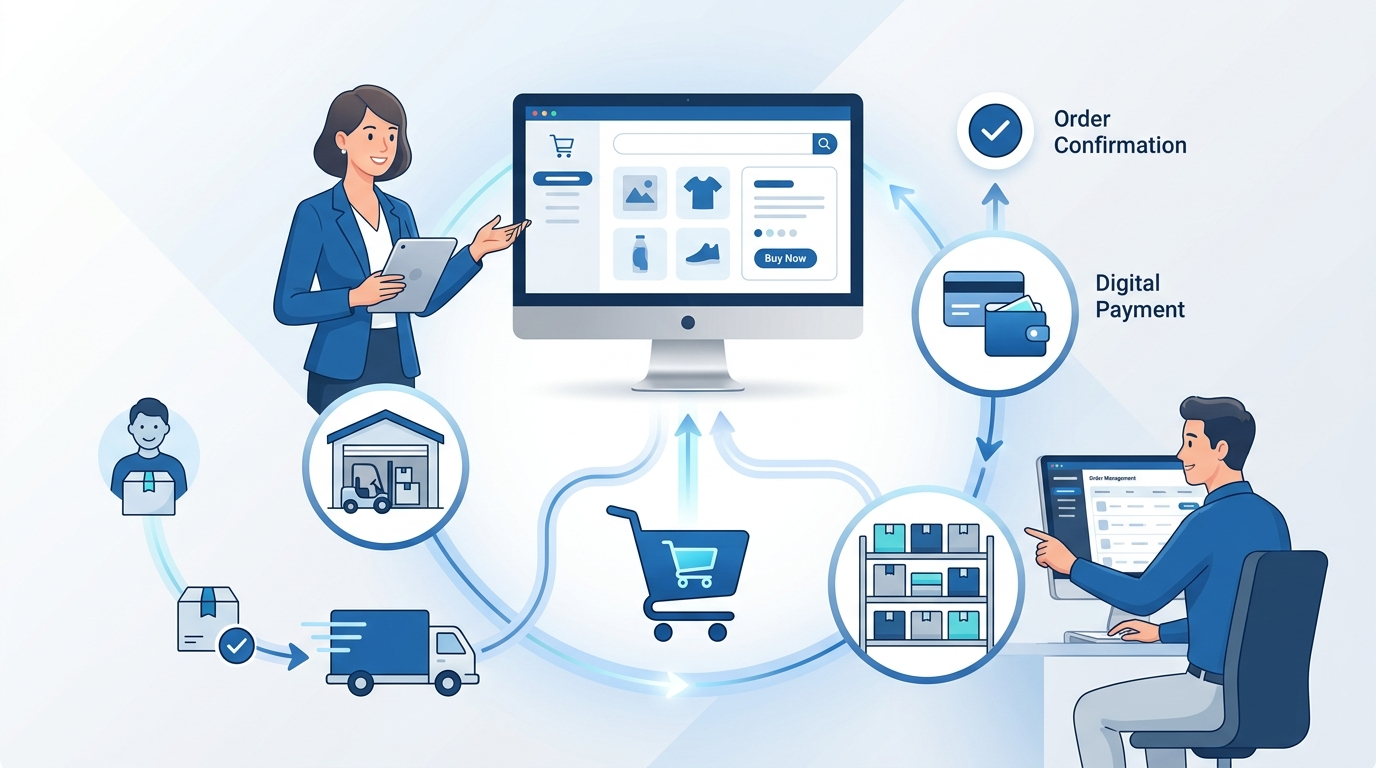
E-commerce is the sale or purchase of goods or services through computer networks using systems designed to place or receive orders. The payment and delivery may happen online or offline. In practice, an e-commerce operation connects a digital storefront, product data, checkout, payments, inventory, fulfillment, customer service, and post-purchase support.
The term is often used as a synonym for online shopping, but the full meaning is broader. Electronic commerce includes consumer purchases from online stores, wholesale orders exchanged between companies, subscription sign-ups, marketplace transactions, app-based purchases, and automated orders sent through electronic data interchange systems.
What Is E-Commerce?
E-commerce, short for electronic commerce, describes a commercial transaction in which a buyer or seller places or receives an order through a computer network. The important factor is the ordering method. A transaction can still qualify as e-commerce when the customer pays in cash on delivery, collects the product from a physical location, or receives a service offline.
This distinction matters because many simplified definitions focus only on online payment. Payment is part of the commercial process, but it does not determine whether the transaction itself is electronic commerce. A customer can order groceries through an app and pay at the door. The order is still an e-commerce transaction because the ordering process occurred through a system designed to receive digital orders.
The 2025 OECD framework also distinguishes structured digital ordering from ordinary communication. Orders submitted through websites, apps, extranets, or electronic data interchange systems are included. A manually typed request sent by email or an order placed through a telephone call is generally excluded because the communication tool was not specifically designed to process the order.
What Counts as an E-Commerce Transaction?
| Scenario | Usually E-Commerce? | Reason |
|---|---|---|
| A customer orders shoes through an online store and pays by card | Yes | The order is placed through a website designed for transactions |
| A customer orders food through an app and pays cash at delivery | Yes | The ordering method is digital even though payment is offline |
| A manufacturer receives an automated wholesale order through EDI | Yes | EDI is a structured computer-to-computer ordering method |
| A customer sends a manually written email asking to buy a product | Usually no | Ordinary email is communication rather than a dedicated ordering system |
| A buyer calls a store and asks an employee to reserve an item | No | The order is placed by telephone, not through a computer ordering system |
| A customer orders online and collects the product in a store | Yes | Physical collection does not change the digital ordering method |
How Does E-Commerce Work?
An e-commerce business may look simple from the customer’s side: find a product, add it to a cart, and complete checkout. Behind that short journey, several systems must exchange accurate information and complete different tasks in the correct order.
1. The Customer Discovers an Offer
The process usually begins through search engines, online advertising, social media, email, marketplaces, referrals, or direct visits. Discovery is not limited to products. A customer may find a subscription, software plan, professional service, digital download, event ticket, or wholesale catalog.
2. The Store Presents Product Information
A website or app displays the product name, description, price, images, availability, delivery options, return conditions, and other details. Product information must be consistent with the inventory and pricing systems. Incorrect descriptions or unavailable items create customer service problems later in the process.
3. The Customer Creates an Order
The cart records selected items, quantities, discounts, taxes, and estimated delivery charges. The checkout then collects the information required to process the order, such as contact details, shipping address, billing information, and the selected delivery method.
4. Payment Is Authorized
A payment gateway or payment service provider sends transaction information between the store, the customer’s payment method, and the relevant financial institutions. Authorization confirms whether the transaction can proceed. Authorization is not always the same as final settlement, and some businesses capture funds only when an order is ready to ship.
5. The Order Enters the Management System
An order management system records the purchase and updates its status. The system may reserve inventory, create an invoice, send confirmation messages, notify warehouse staff, and transfer order data to accounting or customer relationship management software.
6. The Business Fulfills the Order
Physical products must be picked, packed, labeled, and handed to a carrier or prepared for collection. Digital products may be delivered through a download link or user account. Services may trigger appointment scheduling, onboarding, account activation, or another workflow.
7. The Customer Receives Updates
Order confirmation, shipping notifications, tracking information, delivery messages, and support instructions reduce uncertainty. Customers often judge the entire business by the reliability of these communications, especially when delivery is delayed or an item is unavailable.
8. Post-Purchase Operations Begin
The transaction continues after delivery. Returns, refunds, exchanges, warranty claims, reviews, support requests, loyalty programs, and repeat marketing all form part of the customer lifecycle. A store that focuses only on checkout may generate sales but still lose customers through poor post-purchase service.
Core Components of an E-Commerce Business
| Component | Main Function | Operational Risk |
|---|---|---|
| Digital storefront | Presents products, services, prices, and policies | Slow pages, unclear information, or poor mobile usability |
| Product information system | Stores descriptions, images, variants, and specifications | Inconsistent or outdated product data |
| Shopping cart and checkout | Builds the order and collects customer details | Unexpected fees, technical errors, or excessive steps |
| Payment system | Authorizes and processes transactions | Failed payments, fraud, chargebacks, or compliance gaps |
| Inventory management | Tracks stock and product availability | Overselling, stockouts, or inaccurate availability |
| Order management | Coordinates order status across systems | Duplicate, missing, or incorrectly routed orders |
| Fulfillment and logistics | Prepares and delivers physical orders | Delays, damaged goods, and high shipping costs |
| Customer support | Handles questions, complaints, and returns | Slow responses and unresolved problems |
| Analytics | Measures traffic, conversion, revenue, and retention | Decisions based on incomplete or misleading data |
Main Types of E-Commerce
Electronic commerce can be classified by the parties involved in the transaction. The underlying systems may be similar, but pricing, order size, customer expectations, sales cycles, and support requirements can differ significantly.
Business-to-Consumer
Business-to-consumer, or B2C, e-commerce occurs when a company sells directly to an individual. Online fashion stores, food delivery apps, streaming subscriptions, and direct software subscriptions are common examples.
Business-to-Business
Business-to-business, or B2B, e-commerce involves transactions between companies. B2B orders may use negotiated pricing, account approval, purchase orders, credit terms, bulk quantities, and EDI connections. The order values can be much larger than typical consumer purchases.
Consumer-to-Consumer
Consumer-to-consumer, or C2C, transactions take place between individuals, often through a marketplace that provides listings, payments, reputation systems, or dispute support. Second-hand goods and peer-to-peer sales commonly use this model.
Direct-to-Consumer
Direct-to-consumer, or D2C, describes a producer or brand selling to customers without relying entirely on traditional wholesalers and retailers. A D2C brand may operate its own website while also using marketplaces or physical retail partners.
Business-to-Government and Related Models
Businesses can also receive digital orders from government agencies or public organizations. Other classifications include consumer-to-business arrangements, subscription commerce, marketplace commerce, and social commerce. These labels describe the commercial relationship or channel rather than a completely different technology.
Examples of E-Commerce
E-commerce is not limited to a conventional online store that ships physical products. The following activities can all involve electronic commerce:
- buying electronics from a retailer’s website;
- ordering groceries through a mobile app;
- purchasing software through a subscription checkout;
- booking accommodation or transport online;
- downloading an e-book, template, or digital course;
- paying for a professional service through an online booking system;
- buying a used item through a marketplace;
- placing a wholesale order through a supplier portal;
- automatically replenishing inventory through an EDI connection;
- ordering a product online and collecting it from a store.
The common feature is a structured digital order. The product itself can be physical, digital, recurring, customized, or delivered as a service.
Why E-Commerce Matters
E-commerce is now a meaningful part of both consumer retail and business purchasing. The U.S. Census Bureau estimated that retail e-commerce represented 16.9% of total U.S. retail sales in the first quarter of 2026. The same release estimated that online retail sales increased 9.8% from the first quarter of 2025, faster than total retail sales during that period.
European business data shows that electronic sales extend well beyond consumer storefronts. Eurostat reported that e-sales generated 19.49% of total turnover among EU enterprises in 2024. More of that turnover came from EDI-type sales than from orders through websites and apps, showing why a complete e-commerce definition must include automated B2B transactions.
Channel strategy also matters. Among EU enterprises with web sales in 2024, 85.65% used their own websites or apps and 45% used an online marketplace. These percentages overlap because a business can use both channels. The data suggests that marketplaces often complement an owned storefront rather than automatically replacing it.
Advantages and Disadvantages of E-Commerce
| Area | Potential Advantage | Potential Limitation |
|---|---|---|
| Market access | A business can reach customers outside its immediate location | International sales add tax, customs, language, and delivery complexity |
| Operating hours | Customers can place orders at any time | Systems and support expectations continue outside office hours |
| Data | Digital journeys produce measurable behavior and transaction data | Poor tracking or privacy practices can create misleading analysis or compliance risk |
| Automation | Orders can flow automatically into inventory and fulfillment systems | Bad integrations can spread incorrect data across several systems |
| Customer convenience | Search, comparison, ordering, and payment can occur remotely | Customers cannot always inspect physical products before purchase |
| Scalability | A digital catalog can serve many customers without adding physical stores | Traffic growth can expose weaknesses in hosting, inventory, support, and logistics |
| Cost structure | Some businesses can reduce physical retail costs | Advertising, returns, payment fees, software, and shipping can be expensive |
What Most People Get Wrong About E-Commerce
E-Commerce Is Not Just a Website
A website can display products without creating a reliable commercial operation. The business still needs accurate inventory, secure payments, order processing, fulfillment, policies, support, accounting, and data management. The storefront is the visible layer, not the entire system.
Online Payment Does Not Define the Transaction
A cash-on-delivery order can be e-commerce, while a card payment taken after a telephone order may not qualify under a statistical definition. The method used to place the order is the deciding factor.
A Marketplace Is Not the Same as an E-Commerce Platform
A marketplace connects multiple sellers and buyers under one environment. An e-commerce platform is the software used to build or operate digital selling functions. A business may use a platform for its own store and simultaneously sell through one or more marketplaces.
More Traffic Does Not Automatically Produce a Better Business
Traffic has limited value when product information is unclear, checkout fails, stock is inaccurate, delivery is slow, or acquisition costs exceed the contribution from each order. Sustainable electronic commerce depends on the complete operating model, not only visitor volume.
A Practical E-Commerce Example
Consider a small company selling reusable water bottles. The company publishes product pages on its own store, lists selected products on a marketplace, and promotes them through search and social media.
When a customer orders through the company website, the checkout calculates tax and delivery charges. The payment provider authorizes the transaction, the order management system creates the order, and inventory decreases by one unit. Warehouse staff receive a picking request, print a carrier label, and prepare the parcel. The customer receives confirmation and tracking messages.
If the same product sells through the marketplace, the marketplace sends the order to the company’s central system. A reliable inventory connection prevents both channels from selling the final unit at the same time. After delivery, the company records the transaction, handles any return request, and measures whether the customer later makes another purchase.
This example shows why channel expansion without system integration can create problems. Adding another sales channel increases reach, but it also increases the number of places where product data, inventory, orders, prices, and customer messages must remain consistent.
Common E-Commerce Failure Modes
Customer demand is only one part of success. Many stores lose revenue through operational failures that are less visible than marketing performance.
| Failure | Warning Sign | Likely Cause | Prevention |
|---|---|---|---|
| Unexpected checkout abandonment | Many carts but few completed orders | Hidden costs, forced registration, errors, or limited payment methods | Test checkout regularly and show total costs earlier |
| Overselling | Orders must be cancelled after payment | Inventory does not update across channels | Use a central inventory source and reserve stock consistently |
| Slow delivery | Repeated “Where is my order?” messages | Unrealistic promises or poor carrier and warehouse coordination | Use accurate delivery estimates and proactive status updates |
| High return rates | Margins decline despite revenue growth | Weak descriptions, inconsistent sizing, or poor product quality | Improve product information and analyze return reasons by item |
| Payment failures | Customers retry or leave checkout | Gateway issues, fraud controls, or technical integration problems | Monitor authorization rates and provide appropriate alternatives |
| Support overload | Response times rise after sales campaigns | Marketing scales faster than operations | Forecast ticket volume and publish clear self-service information |
Consumer data confirms that post-purchase execution is a major part of the experience. In a 2025 Eurostat survey, 35.4% of recent EU online shoppers reported a problem. Slow delivery was the most frequently reported issue, followed by difficult website use and incorrect or damaged goods. The lesson is practical: checkout completion is not the end of e-commerce quality.
E-Commerce, E-Business, and Online Retail
| Term | Meaning |
|---|---|
| E-commerce | Digitally ordered sales or purchases of goods and services |
| E-business | A broader concept covering digital business processes, including operations that may not involve a sale |
| Online retail | Consumer retail sales completed through digital ordering channels |
| Digital marketplace | A platform that brings multiple sellers and buyers together |
| Social commerce | Product discovery and ordering integrated into social platforms or social interactions |
Every online retail transaction is a form of e-commerce, but not every e-commerce transaction is retail. Automated wholesale purchasing between manufacturers and suppliers is electronic commerce even though no consumer storefront is involved.
Frequently Asked Questions
What does e-commerce mean?
E-commerce means buying or selling goods or services through a computer network using a system designed to place or receive orders. The payment and final delivery do not have to happen online. Websites, mobile apps, extranets, and EDI systems can all support electronic commerce.
Is e-commerce the same as online shopping?
Online shopping is a major form of e-commerce, but the terms are not identical. Electronic commerce also includes B2B supplier portals, automated EDI orders, digital subscriptions, service bookings, marketplace transactions, and transactions involving public organizations.
Does cash on delivery count as e-commerce?
Yes, a cash-on-delivery purchase can count as e-commerce when the order was placed through a website, app, or another digital ordering system. The ordering method determines the classification, not the payment method.
What is an e-commerce website?
An e-commerce website is a website designed to present offers and receive digital orders. It commonly includes product pages, a cart, checkout, payment connections, order management, inventory information, customer accounts, policies, and support features.
What is the difference between an e-commerce website and a marketplace?
An e-commerce website usually represents one business or brand, while a marketplace hosts offers from multiple sellers. A company can operate its own website and also use marketplaces to reach additional customers.
Can services be sold through e-commerce?
Yes. Electronic commerce can involve physical products, digital goods, subscriptions, bookings, professional services, transportation, accommodation, entertainment, and many other paid offers. The defining feature is the structured digital order.
What are the basic requirements for an e-commerce business?
An e-commerce business needs a clear offer, reliable product or service information, an ordering system, suitable payment options, order management, fulfillment or service delivery, customer support, legal policies, security controls, and a method for measuring performance.
Final Summary
E-commerce is best understood as a digitally ordered commercial transaction, not simply as a card payment on a website. The order may involve a consumer, a business, a government organization, a physical product, a digital service, or an automated wholesale system.
A successful e-commerce operation connects customer-facing pages with payments, inventory, order management, fulfillment, communication, support, and analytics. The strongest businesses treat these components as one coordinated system. A polished storefront can attract an order, but reliable operations determine whether the transaction becomes a satisfied customer and a sustainable business.