
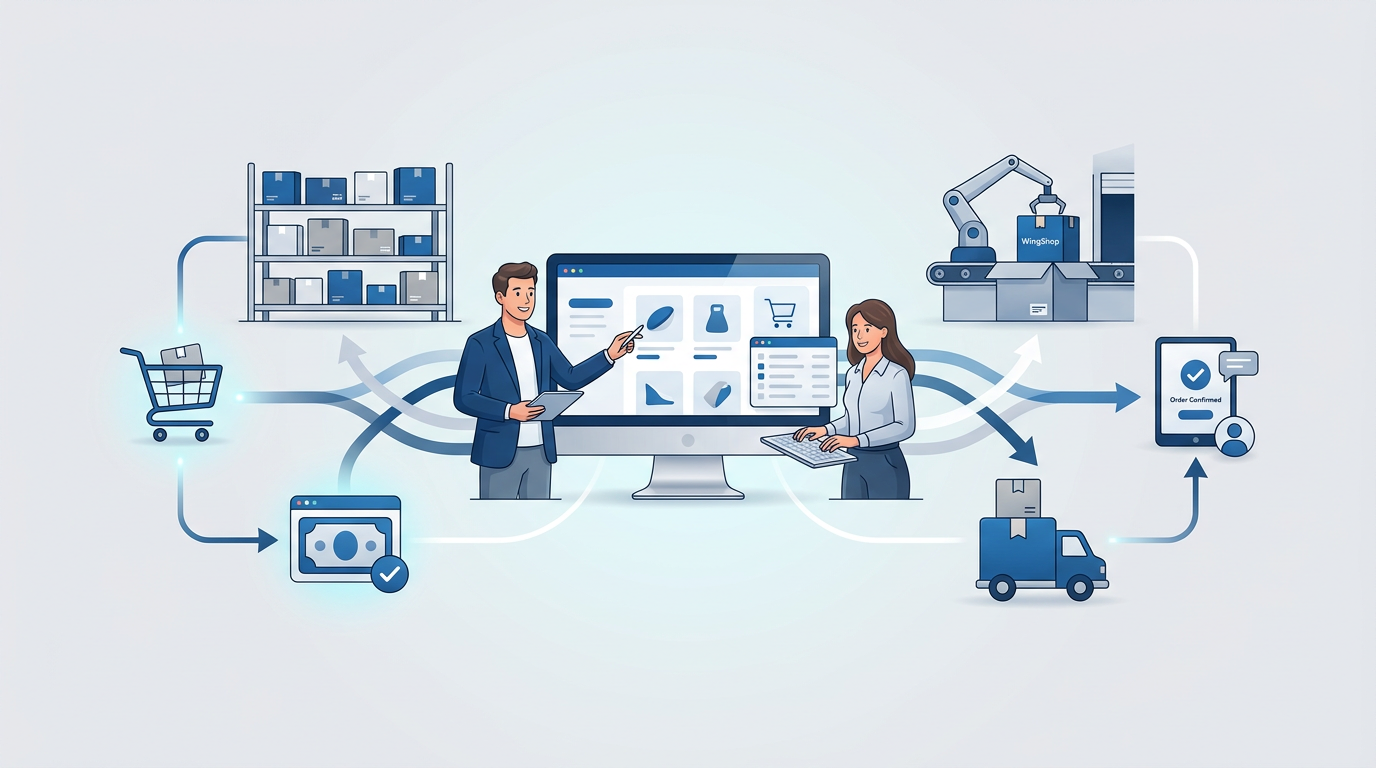
E-commerce marketing is the coordinated use of search, advertising, content, social media, email, marketplaces, creators, and retention programs to attract qualified shoppers and turn them into profitable customers. A strong strategy connects every channel to a specific role in the customer journey, measures contribution beyond last-click sales, and protects margin instead of pursuing traffic at any cost.
Online stores often describe marketing as a collection of promotional activities. That description is incomplete. E-commerce marketing links customer demand to product economics, website experience, inventory availability, payment performance, fulfillment, and repeat purchasing. Marketing cannot create sustainable growth when the store loses money on each new customer or fails to deliver the promised experience.
Readers who need a foundation can first review our guide to e-commerce basics. The commercial process matters because marketing performance depends on what happens after a person clicks an advertisement or opens a campaign message.
What Is E-Commerce Marketing?
E-commerce marketing is the process of creating demand, capturing existing demand, converting shoppers, and increasing customer value for a business that receives orders through digital channels. The process may promote an independent online store, a marketplace listing, a mobile app, a subscription, a digital product, or an omnichannel retail operation.
The primary objective is not simply to generate visits. The objective is to acquire and retain customers at an economically sustainable cost. A campaign that produces many orders can still damage the business when discounts, advertising fees, payment costs, returns, shipping, and support consume the available margin.
Ecommerce marketing therefore requires coordination between several functions:
- Audience development identifies people with a relevant need or purchase intent.
- Positioning explains why the offer is useful and different.
- Channel management places the message where customers discover and evaluate options.
- Conversion helps qualified shoppers complete an order.
- Retention encourages repeat purchases and stronger customer relationships.
- Measurement estimates which activity caused incremental business results.
Why E-Commerce Marketing Matters
Digital buying is a mainstream behavior rather than a niche activity. In 2025, 78% of internet users in the European Union bought or ordered goods or services online. In the United States, retail e-commerce represented 16.9% of total retail sales in the first quarter of 2026. These figures indicate a large addressable market, but they do not guarantee that an individual store can acquire customers efficiently.
Competition for attention is also substantial. U.S. internet advertising revenue reached approximately $294.6 billion in 2025. Social media advertising alone reached $117.7 billion, while programmatic advertising reached $162.4 billion. Rising investment creates more opportunities to reach shoppers, but it also increases auction pressure, creative competition, and measurement complexity.
The Five Jobs of an E-Commerce Marketing Strategy
A useful strategy assigns marketing activity to five distinct jobs. Combining all activity into one general campaign makes performance difficult to diagnose.
1. Create Demand
Demand creation introduces a problem, category, product, or brand to people who are not actively searching for it. Video, creator partnerships, social content, display advertising, public relations, and educational content can perform this role.
Demand creation usually produces weaker immediate conversion than demand capture because the audience has not yet decided to buy. The value appears through increased branded search, direct visits, assisted conversions, new audience formation, and later purchases. Judging these campaigns only by last-click return can lead a business to stop the activity that creates future demand.
2. Capture Existing Demand
Demand capture reaches shoppers who are already evaluating options or expressing purchase intent. Search advertising, shopping feeds, marketplace visibility, product comparison pages, affiliate content, and organic search commonly serve this purpose.
Demand capture often converts efficiently because it appears near the purchase decision. However, it can also receive too much credit. A customer who searches for a brand name after seeing a creator video may complete the order through a paid search advertisement. The search campaign records the sale, but the earlier exposure may have created the preference.
3. Convert Qualified Shoppers
Conversion marketing reduces uncertainty between product discovery and checkout. Product pages, customer reviews, pricing, delivery information, guarantees, payment choices, merchandising, and cart recovery all affect conversion.
Conversion is not limited to changing button colors or adding urgency messages. The strongest improvement may come from fixing inaccurate product details, showing the full delivered price earlier, improving mobile speed, clarifying returns, or removing an unnecessary checkout step.
4. Retain Customers
Retention marketing increases the value of an existing customer relationship. Email, SMS, loyalty programs, replenishment reminders, personalized recommendations, customer service, subscriptions, and post-purchase education can support repeat purchasing.
5. Learn What Actually Works
Measurement determines whether marketing caused an outcome that would not otherwise have occurred. Platform dashboards are useful operational tools, but attributed revenue is not automatically incremental revenue. A platform can claim credit for a customer who was already likely to purchase.
A mature measurement system combines transaction analytics, contribution margin, attribution, controlled experiments, and broader models such as marketing mix modeling. Experiments are especially valuable because they compare exposed and unexposed groups or regions to estimate causal lift.
Main E-Commerce Marketing Channels
| Channel | Best Role | Main Strength | Main Risk |
|---|---|---|---|
| Organic search | Demand capture and education | Compounds over time and matches specific intent | Slow results and dependence on search visibility |
| Paid search and shopping ads | Demand capture | Reaches shoppers close to a decision | High competition and over-crediting branded demand |
| Social media advertising | Demand creation, retargeting, and product discovery | Strong creative formats and audience reach | Creative fatigue and unstable acquisition costs |
| Content marketing | Education, trust, and organic discovery | Answers questions throughout the buying journey | Generic content can attract readers with little purchase intent |
| Email marketing | Conversion, retention, and lifecycle communication | Direct access to an opted-in audience | List fatigue, poor segmentation, and excessive promotion |
| SMS and mobile messaging | Time-sensitive conversion and retention | Fast visibility for relevant messages | Intrusive frequency and consent requirements |
| Creator and influencer marketing | Demand creation and social proof | Demonstrates products in a trusted context | Weak disclosure, audience mismatch, or unreliable attribution |
| Affiliate marketing | Demand capture and third-party distribution | Performance-based commercial model | Coupon leakage, brand bidding, and low-quality partners |
| Marketplaces | Demand capture and channel expansion | Access to established shopper traffic | Fees, price competition, and limited customer ownership |
| Retail media | Sponsored visibility near purchase | Uses retailer transaction context | Fragmented reporting and overlapping attribution |
How to Build an E-Commerce Marketing Strategy
Step 1: Start With Unit Economics
Marketing planning should begin with the amount a business can afford to spend on customer acquisition. Revenue alone is an unsafe guide because two orders with the same selling price can produce very different profit.
Estimate the contribution available after product cost, discounts, payment fees, shipping subsidies, packaging, marketplace fees, expected returns, and variable service costs. A campaign target should reflect this contribution rather than gross revenue.
For example, a store may sell a product for $100 and report a return on ad spend of 3.0 after spending $33 to acquire the order. The result looks attractive until the business subtracts a $40 product cost, $12 shipping subsidy, $5 payment and packaging costs, and an expected return allowance. The campaign can create revenue while producing little or no operating contribution.
Step 2: Define the Customer and Purchase Situation
A useful audience definition describes the customer’s need, trigger, constraints, and decision criteria. Demographics alone rarely explain why a person chooses one product.
- What event causes the customer to begin looking?
- What alternatives does the customer consider?
- Which risks or uncertainties delay the decision?
- Which specifications, price points, or service conditions matter?
- Is the purchase planned, urgent, habitual, seasonal, or emotional?
Customers often move repeatedly between exploration and evaluation before buying. Marketing should therefore make the product easy to discover while also supplying the evidence needed to compare it with alternatives.
Step 3: Give Every Channel a Defined Role
A channel plan should state what each channel is expected to accomplish. Search may capture active demand, creator content may demonstrate the product, email may recover incomplete purchases, and post-purchase messaging may encourage repeat use.
Step 4: Build the Offer Before Scaling Traffic
An offer includes more than the product. The offer also includes price, bundle structure, delivery promise, payment options, returns, guarantee, support, and the reason to act now.
Advertising cannot permanently compensate for an offer that is hard to understand or unattractive relative to available alternatives. Before increasing traffic, confirm that the product page answers the customer’s major questions and that the store can fulfill the promise consistently.
Step 5: Match Creative to Customer Questions
Creative should perform a specific communication job. One advertisement may introduce the problem, another may demonstrate the product, and another may answer an objection about size, quality, compatibility, or delivery.
A practical creative library can include:
- problem-and-solution demonstrations;
- product use cases;
- comparisons with common alternatives;
- customer questions and objections;
- unboxing and setup content;
- proof of materials, construction, or performance;
- post-purchase education;
- seasonal or situational messages.
Step 6: Design the Landing Experience Around the Message
The landing page should continue the promise made in the advertisement. Sending every campaign to the homepage forces customers to repeat their search and can create a mismatch between message and destination.
A product-specific advertisement should normally lead to the relevant product or collection. Educational content may lead to a guide that naturally introduces suitable products. A promotion should lead to a page where eligibility, products, exclusions, and deadlines are clear.
Step 7: Establish a Measurement Plan Before Launch
Define the primary business outcome, supporting metrics, comparison period, attribution approach, and test method before the campaign begins. Changing the success metric after seeing results creates biased decisions.
A basic measurement plan should answer:
- Which conversion event represents commercial value?
- How will cancelled and returned orders be handled?
- Will performance use revenue, gross margin, or contribution margin?
- Which attribution window is appropriate for the purchase cycle?
- How will new and returning customers be separated?
- Can an incrementality experiment be used?
Important E-Commerce Marketing Metrics
| Metric | What It Measures | Important Limitation |
|---|---|---|
| Conversion rate | Share of visits or users that complete an order | Can rise when low-intent traffic falls, even if sales do not grow |
| Average order value | Average revenue per completed order | Higher order value may come from discounts that reduce margin |
| Customer acquisition cost | Acquisition spend divided by acquired customers | Must define which costs and which customers are included |
| Return on ad spend | Attributed revenue divided by advertising spend | Ignores margin and may overstate causal impact |
| Contribution after marketing | Order contribution remaining after variable marketing cost | Requires reliable cost, return, and discount data |
| New customer rate | Share of orders from first-time buyers | Identity limitations can misclassify customers |
| Repeat purchase rate | Share of customers who order again | Must match the natural repurchase cycle of the product |
| Customer lifetime value | Expected long-term contribution from a customer | Early estimates can be overly optimistic |
| Return rate | Share of sold items or orders returned | Should be analyzed by product, reason, and acquisition source |
Why Attribution Is Not the Same as Incrementality
Attribution assigns credit for a conversion among recorded touchpoints. Incrementality estimates whether the marketing activity caused additional conversions. The difference is central to e-commerce performance analysis.
Suppose a loyal customer visits a store directly, leaves, sees a retargeting advertisement, and buys an hour later. The advertising platform may attribute the sale to retargeting. An incrementality test may show that many similar customers would have purchased without the advertisement.
No single measurement method solves every problem:
- Platform attribution supports daily campaign management but can favor the platform reporting the result.
- Web analytics provides a cross-channel view but depends on tracking quality and attribution rules.
- Controlled experiments provide stronger causal evidence but require suitable scale and test design.
- Marketing mix modeling estimates broader channel contribution using aggregated data but is less useful for daily keyword or creative decisions.
The best practical approach combines these methods. Use attribution for operational optimization, experiments for causal validation, and broader models for budget allocation when sufficient data is available.
A Practical E-Commerce Marketing Example
Consider a small online brand selling premium reusable water bottles. The product sells for $48, has a healthy gross margin, and is typically repurchased only when customers buy gifts or additional sizes.
Demand Creation
The brand publishes short videos showing leak testing, cleaning, insulation performance, and use during commuting or travel. Selected creators demonstrate the bottle in realistic situations. The creative focuses on product proof rather than generic lifestyle imagery.
Demand Capture
Search and shopping campaigns target people actively comparing insulated bottles. Product feeds contain accurate titles, colors, capacities, prices, and availability. Collection pages help shoppers compare sizes without returning to search results.
Conversion
The product page explains dimensions, weight, cleaning instructions, delivery time, returns, and replacement parts. A bundle offers a bottle and cleaning brush without applying a sitewide discount. Abandoned-cart messages remind opted-in shoppers but stop when the product becomes unavailable.
Retention
Post-purchase email explains cleaning and care, then introduces compatible lids and gift options later. Customers are not sent weekly discounts because the product does not have a short replenishment cycle.
Measurement
The business tracks contribution after advertising, shipping subsidy, payment cost, and expected returns. It separates branded and non-branded search, compares new and returning customers, and periodically pauses retargeting for a randomly selected audience group to estimate incremental lift.
This example shows how channels work as a system. No single campaign carries the full strategy. Creative generates interest, search captures intent, the product page reduces uncertainty, lifecycle messages improve customer value, and experiments test whether attributed results are truly incremental.
Common E-Commerce Marketing Failures
| Failure | Why It Happens | Warning Sign | Better Approach |
|---|---|---|---|
| Scaling revenue without margin controls | Teams optimize for platform revenue or headline ROAS | Sales rise while cash and contribution decline | Set targets using product-level contribution and expected returns |
| Relying on one acquisition channel | One platform performs well during an early growth period | A policy or auction change causes an immediate sales drop | Develop complementary demand creation, capture, and retention channels |
| Sending all traffic to the homepage | Campaign setup is faster and easier | High clicks with weak product-page engagement | Match campaign intent to a specific product, collection, or guide |
| Using discounts as the main message | Discounts produce a visible short-term response | Customers wait for promotions and margin deteriorates | Improve differentiation, bundles, service, and product proof |
| Treating all attributed sales as incremental | Platform dashboards are accepted without validation | Multiple platforms claim overlapping conversions | Use holdouts, geo tests, and blended business metrics |
| Ignoring returns and cancellations | Marketing reports use order-time revenue | Campaigns look profitable before return data arrives | Feed net sales and return-adjusted value into reporting |
| Publishing generic content at scale | Volume is mistaken for topical authority | Traffic has low commercial relevance and weak engagement | Answer specific customer questions with evidence and product context |
| Expanding channels before fixing operations | Traffic growth appears easier than process improvement | Support tickets, delays, and negative reviews increase | Resolve stock, checkout, fulfillment, and service failures before scaling |
Reviews, Influencers, and Marketing Compliance
Reviews and creator endorsements can reduce purchase uncertainty, but deceptive social proof creates legal and reputational risk. Businesses should not buy fake reviews, condition incentives on positive sentiment, misrepresent independent experiences, or suppress legitimate negative feedback through intimidation.
In the United States, the Consumer Reviews and Testimonials Rule took effect on October 21, 2024. The rule addresses practices involving fake reviews, certain insider testimonials, review suppression, and false indicators of social influence. Material relationships between a brand and an endorser should also be disclosed clearly where consumers can notice and understand the disclosure.
Compliance requirements vary by jurisdiction, platform, message type, and data practice. E-commerce businesses should review applicable advertising, privacy, consent, pricing, and consumer-protection rules before launching campaigns.
Frequently Asked Questions
What is e-commerce marketing?
E-commerce marketing is the coordinated use of digital channels to create demand, attract qualified shoppers, convert orders, and retain customers for a business that sells through online ordering systems. Effective e-commerce marketing connects campaigns to product margin, customer experience, fulfillment, and long-term customer value.
What are the main e-commerce marketing channels?
The main channels include organic search, paid search, shopping ads, social media, content, email, SMS, creator partnerships, affiliates, marketplaces, retail media, and referral programs. Each channel should have a defined role in demand creation, demand capture, conversion, or retention.
What is the best marketing channel for an online store?
There is no universal best channel. Search is often effective when customers already look for the product. Social and creator content can be stronger when the product needs demonstration. Email is valuable for retention when customers have consented and the product has a realistic repeat-purchase opportunity.
What is a good return on ad spend?
A good return on ad spend is one that produces acceptable contribution and cash flow after product cost, discounts, fees, shipping, returns, and other variable expenses. The same ROAS can be profitable for a high-margin product and unprofitable for a low-margin product.
Is content marketing useful for e-commerce?
Content marketing for e-commerce is useful when it answers questions that influence discovery, evaluation, product use, or purchase confidence. Generic traffic-focused articles may produce little commercial value. Strong content connects a specific customer problem with evidence, decision criteria, and relevant products.
How should e-commerce marketing performance be measured?
E-commerce marketing performance should combine order data, contribution margin, new-customer acquisition, retention, returns, attribution, and incrementality testing. Platform-reported revenue is useful for campaign management but should not be treated as definitive proof that the platform caused every attributed sale.
Final Summary
E-commerce marketing is a commercial operating system, not a list of promotional channels. A complete strategy creates demand, captures active intent, improves conversion, retains customers, and measures whether activity caused profitable growth.
The strongest plan starts with unit economics and customer needs. Each channel receives a defined role, creative answers a real buying question, landing pages continue the campaign promise, and reporting accounts for margin, returns, repeat purchasing, and incrementality.