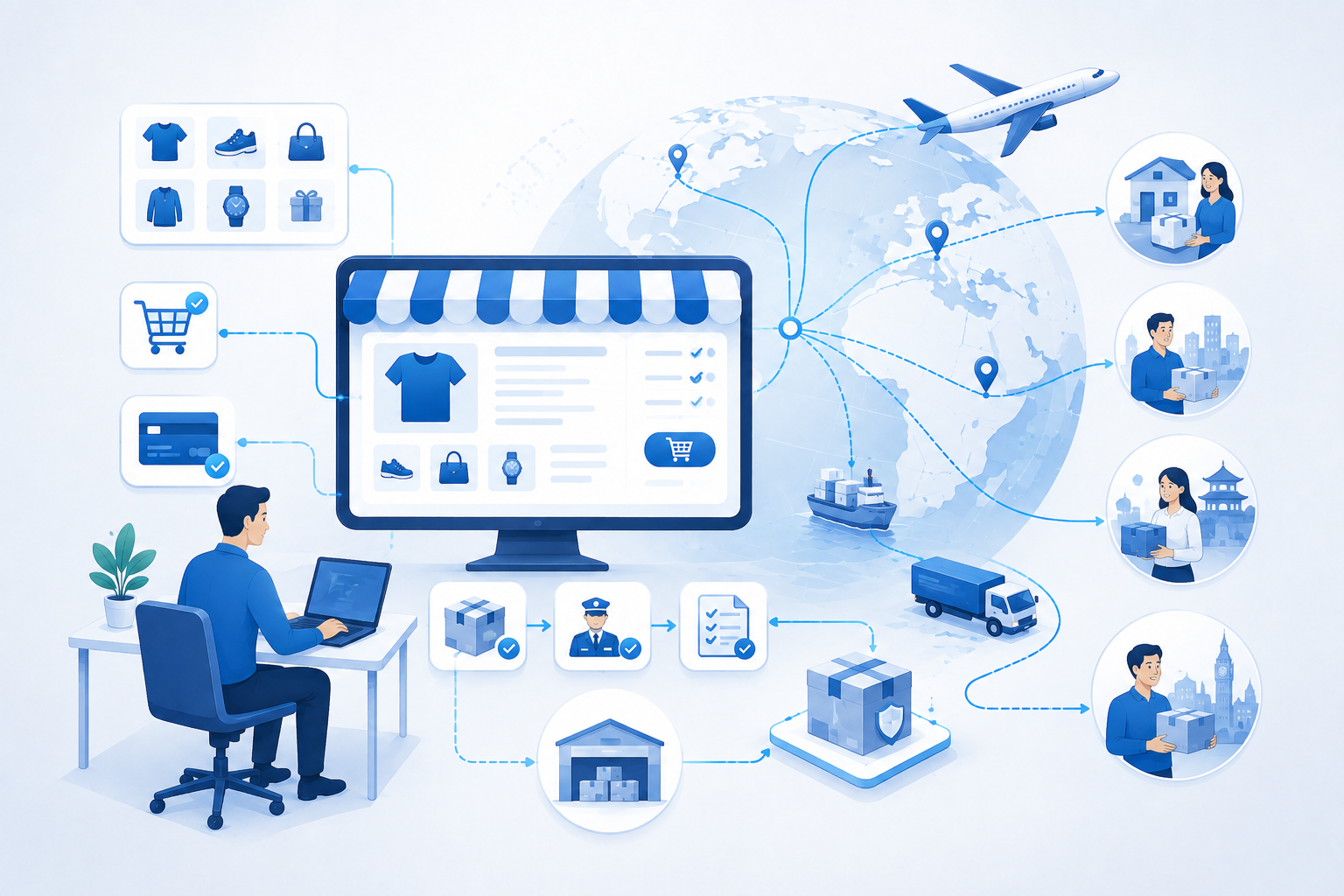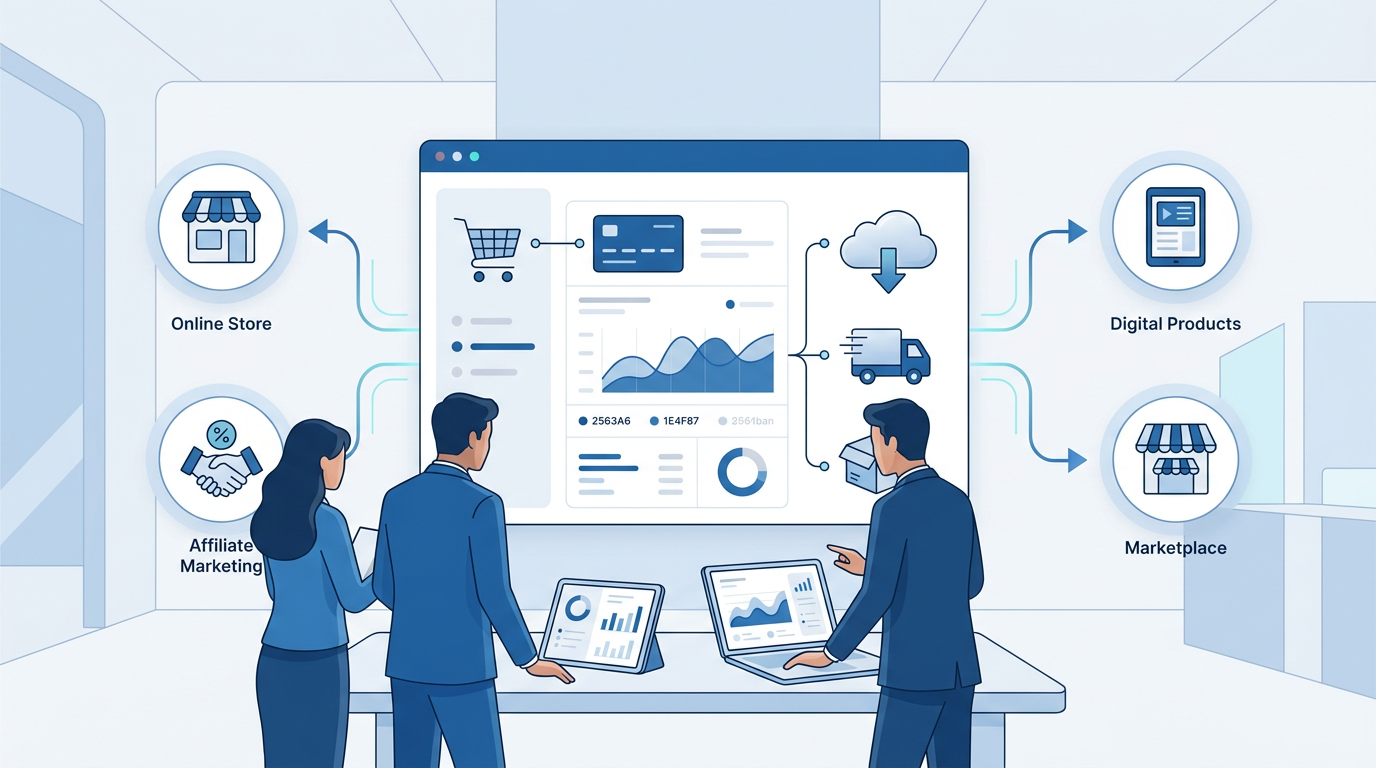
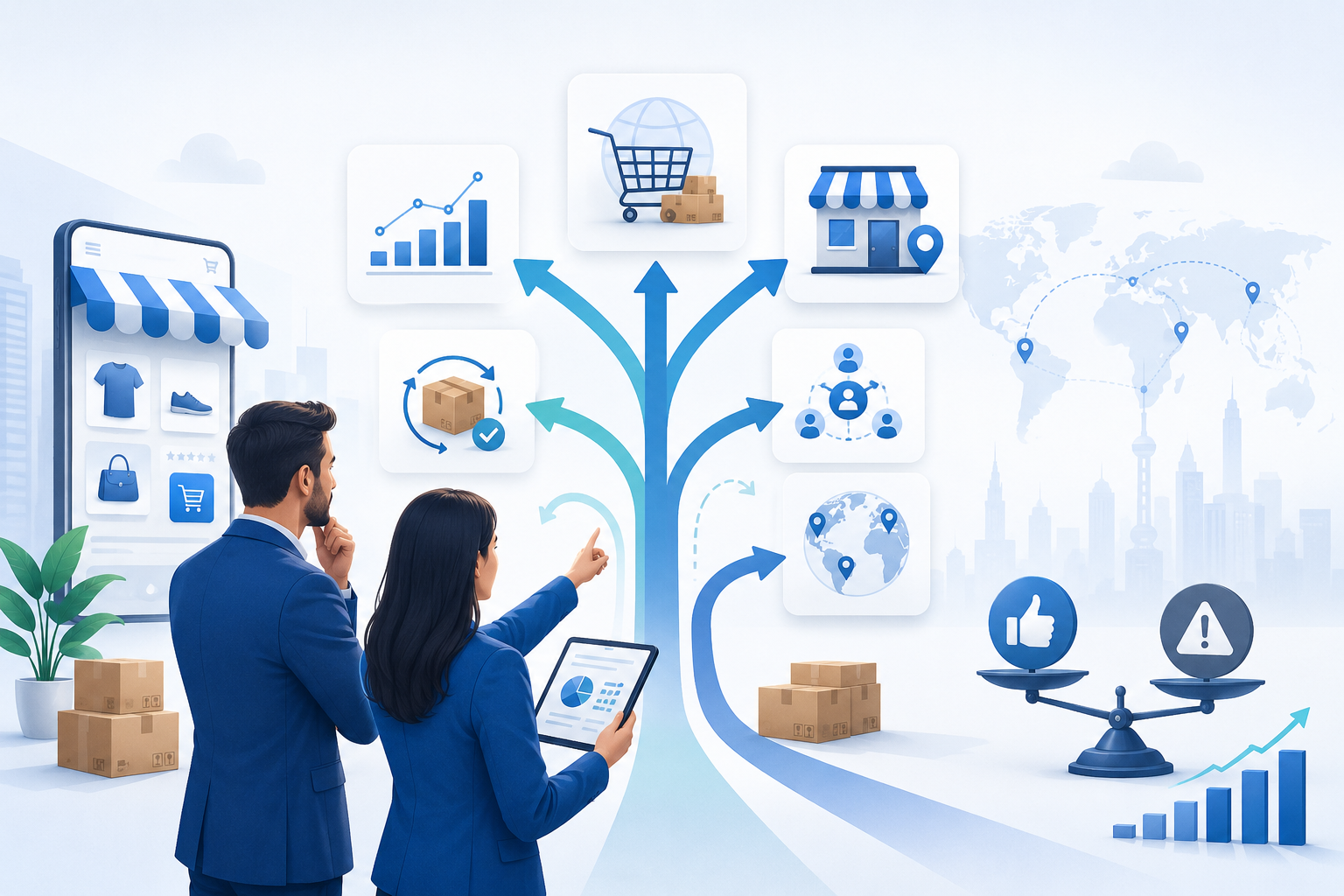
E commerce opportunities arise when digital ordering helps a business reach customers more efficiently, serve new markets, improve product discovery, collect better demand signals or create revenue models that are difficult to operate offline. The opportunity is valuable only when customer demand, margins, fulfillment, technology and support can sustain the additional sales.
E-commerce is often described as a simple path to wider reach and lower operating costs. That description is incomplete. Digital sales can reduce some barriers while creating new costs in acquisition, delivery, returns, software, fraud control and customer service.
The strongest online opportunities usually come from one of four changes: a larger reachable market, a better customer experience, a more efficient operating process or a new way to earn revenue. A company does not need to pursue all four at once. A narrow opportunity with clear economics can be more valuable than a large transformation with uncertain ownership.
Readers who need the underlying definition can first review e-commerce basics.
What Are E-Commerce Opportunities?
E-commerce opportunities are commercially useful ways to receive and manage digitally placed orders. They may include selling existing products online, entering another geographic market, serving business buyers through a portal, adding subscriptions, building a marketplace, supporting store pickup or using digital demand data to improve product and inventory decisions.
The OECD definition of e-commerce focuses on how the order is placed rather than how payment or delivery occurs. This means an opportunity can involve home delivery, digital fulfillment, store collection, invoice payment or another process, provided the order is submitted through a system designed to receive it.
Digital demand is large enough to matter for businesses of many sizes. In 2025, 78% of internet users in the European Union reported buying or ordering goods or services online. Eurostat also reported that e-sales generated 19.49% of total turnover among EU enterprises in 2024. These figures do not guarantee that every product should move online, but they show that digital ordering is a part of customer behavior.
The Seven Opportunity Paths
| Opportunity Path | Commercial Value | Main Requirement |
|---|---|---|
| New customer reach | Sell beyond the limits of a physical location or current sales team | Demand, delivery and support in the target market |
| Greater customer convenience | Allow customers to research and order at suitable times | Accurate product, price and availability information |
| New revenue model | Add subscriptions, digital products, marketplaces or services | Clear responsibilities and sustainable unit economics |
| Operational automation | Reduce manual work in ordering, payment and communication | Connected systems and exception handling |
| Better demand intelligence | Use search, browsing and order data to improve decisions | Reliable measurement and privacy controls |
| Omnichannel growth | Connect stores, pickup, local inventory and digital ordering | Inventory accuracy and coordinated policies |
| Cross-border expansion | Reach buyers in additional countries | Tax, customs, logistics, language and return readiness |
This framework prevents a common planning error: defining the goal as “launch e-commerce.” The real goal should describe which commercial path the business wants to open and how success will be measured.
Benefits of E-Commerce for Businesses
Access to a Larger Addressable Market
A physical business is limited by location, opening hours and local customer flow. Digital ordering can expand the reachable market to other cities, regions or countries. Marketplaces can also place smaller sellers in front of customers they could not attract independently.
Reach is not the same as demand. The business must still earn attention, communicate trust and deliver the product economically. A theoretically global audience has little value when shipping cost, language or regulation prevents conversion.
Continuous Product Discovery
An online catalog can remain visible outside normal business hours. Customers can compare products, read specifications, save items and return later. This is especially valuable for purchases that require research before contact with a salesperson.
Lower Entry Cost for Some Business Models
Some online models can begin without a large customer-facing property or broad store network. Digital products, made-to-order goods, marketplace selling and limited product launches may reduce the capital needed for a traditional retail footprint.
This advantage should not be overstated. The cost does not disappear; it changes form. The business may spend more on software, content, advertising, fulfillment and returns.
Better Demand Feedback
Online systems can reveal which products customers view, search, compare, add to carts and purchase. These signals can help the business improve assortment, pricing, content and inventory.
Behavioral data needs interpretation. A frequently viewed product may be attractive, confusing or overpriced. Order and margin data are required before the business acts on attention alone.
Automation of Routine Transactions
Digital ordering can reduce repetitive work in order entry, confirmations, payment requests and status communication. Employees can focus on exceptions, complex sales and customer problems.
Automation creates value only when normal and abnormal workflows are both defined. A system that accepts orders automatically but requires manual correction for stock, tax or refunds may increase total workload.
Advantages and Disadvantages of E-Commerce
| Area | Potential Advantage | Potential Disadvantage |
|---|---|---|
| Market reach | Access to customers beyond the local area | More competition and higher customer-acquisition cost |
| Availability | Orders can be placed at any time | Customers expect continuous system reliability and support |
| Operating cost | Less dependence on customer-facing physical space | Software, logistics, payment and returns can be expensive |
| Customer data | More visibility into discovery and buying behavior | Privacy, security and data-quality responsibilities increase |
| Scale | Digital processes can support higher order volume | Weak processes fail faster when volume rises |
| Product choice | A wider catalog can be presented online | Complexity can make discovery and inventory harder |
| Expansion | New markets can be tested with limited physical presence | Tax, customs, language and delivery rules vary |
| Measurement | Campaign and transaction performance can be tracked | Attribution can overstate the impact of a channel |
The advantages and disadvantages of e commerce usually come from the same capability. Wider reach creates more potential customers and more competitors. Automation reduces routine work but increases dependency on systems. Better data supports decisions but creates privacy and security obligations.
Opportunity 1: Selling Existing Products Through New Channels
The simplest opportunity is to offer existing products through a website, marketplace, mobile interface or B2B portal. The business already understands the product, supplier and customer problem, which reduces some startup uncertainty.
The channel still needs its own economic test. Marketplace commissions, payment fees, advertising, packaging and returns may change the margin. Product content may also need more detail because online customers cannot inspect the item directly.
Best Fit
- products with repeatable specifications;
- items that can be shipped or collected reliably;
- customers who already research online;
- businesses with dependable inventory records;
- offers with enough margin to support channel costs.
Warning Signs
- each order requires extensive manual negotiation;
- delivery cost is high relative to product value;
- return risk is difficult to control;
- supplier stock cannot be verified;
- the product depends on physical inspection with no digital substitute.
Opportunity 2: Creating a Direct Customer Relationship
A manufacturer or brand can use digital commerce to sell directly to customers rather than relying entirely on distributors or retailers. Direct sales may provide better access to customer feedback, product usage and repeat-purchase behavior.
Direct-to-customer selling also transfers responsibilities. The business becomes responsible for acquisition, payment, fulfillment, returns and service. A higher selling price does not automatically mean a higher profit after these costs.
The direct channel can also create conflict with existing partners. Pricing, territory and product availability should be planned so the business does not unintentionally undermine relationships that still create value.
Opportunity 3: Building Recurring Revenue
Subscriptions can convert repeated purchasing into a managed relationship. Suitable products include replenishment goods, memberships, software, research, digital services and curated deliveries.
Recurring revenue is attractive because it may improve demand visibility and customer retention. The model becomes weak when customers are enrolled without clear consent, cancellation is difficult or the product does not provide recurring value.
A subscription opportunity should answer:
- why the customer needs repeated access or delivery;
- how often the value is created;
- what happens when payment fails;
- how customers pause or cancel;
- how the business measures churn and contribution.
Opportunity 4: Serving Business Buyers Digitally
B2B e-commerce can simplify quotation, reordering, approval and account management. Business customers may need contract pricing, purchase orders, tax documentation, credit terms and several users under one organization.
A portal can reduce manual order entry and make standard products easier to reorder. Sales employees can then focus on account development and complex opportunities rather than routine administration.
Opportunity 5: Expanding Across Borders
Digital channels can expose a business to customers in additional countries without opening a full physical operation in each market. The World Bank has supported programs that help smaller firms enter international B2B marketplaces and improve digital trade readiness.
Cross-border e-commerce requires more than translation. The business must review:
- product restrictions and local standards;
- tax, customs and import obligations;
- delivery time and landed cost;
- currency and payment acceptance;
- returns and customer-service language;
- local consumer-protection expectations;
- trademark and product-liability exposure.
A useful market is not merely one where customers click. It is one where the business can deliver a compliant order, resolve problems and retain acceptable contribution.
Opportunity 6: Combining Online and Offline Commerce
Retailers can use digital ordering to support store pickup, local delivery, appointments, reservations and store returns. The physical network becomes a service and fulfillment asset rather than a separate channel.
The opportunity depends on inventory accuracy and store execution. A pickup promise creates disappointment when the product cannot be found. Store employees also need time, space and systems for picking, staging and customer handoff.
Opportunity 7: Using Data to Improve the Business
Digital commerce produces demand signals before and after purchase. Searches can reveal missing products. Product views can reveal interest. Return reasons can reveal specification or quality problems. Repeat behavior can reveal whether the customer value continues after the first order.
The business should connect behavior with actual orders, costs and returns. Our guide to performance tracking explains why website data, transaction records and contribution data serve different purposes.
How to Evaluate an E-Commerce Opportunity
A useful opportunity passes five tests.
| Test | Question | Evidence |
|---|---|---|
| Customer | Does a defined customer value the digital offer? | Interviews, search behavior, test orders or preorders |
| Economic | Does the order create acceptable contribution? | Product, payment, acquisition, delivery and return costs |
| Operational | Can the business fulfill the promise reliably? | Inventory, lead-time and test-order results |
| Technical | Can systems exchange accurate data? | Payment, order, inventory and refund testing |
| Strategic | Does the opportunity strengthen the business? | Customer ownership, capabilities and channel fit |
An opportunity that passes only the customer test may produce demand but lose money. An opportunity that passes only the economic test may look profitable in a spreadsheet but fail during delivery or customer service.
The Opportunity Economics
Revenue should be separated from value created.
Contribution per order = net revenue − product cost − payment fees − fulfillment − shipping subsidy − expected returns − acquisition cost.
Assume an order produces $100 in net revenue. Product cost is $42, payment and platform fees are $6, fulfillment and delivery cost $14, expected return cost is $8 and acquisition cost is $20. The contribution is $10.
| Illustrative Order | Amount |
|---|---|
| Net revenue | $100 |
| Product cost | -$42 |
| Payment and platform fees | -$6 |
| Fulfillment and shipping | -$14 |
| Expected returns | -$8 |
| Customer acquisition | -$20 |
| Contribution | $10 |
The opportunity may still be attractive if repeat purchases increase customer value, but the business should use observed retention rather than optimistic assumptions.
Practical Example: A Regional Home-Goods Business
Consider a home-goods retailer with two stores and a reliable customer base. Management wants national online sales because customers frequently ask whether products can be ordered remotely.
Stage 1: Narrow the Opportunity
The retailer does not place the entire catalog online. It begins with 60 products that have clear dimensions, stable supply, manageable delivery and low damage risk.
Stage 2: Validate Economics
The team calculates packaging, payment, delivery, returns and customer acquisition. Large fragile items are excluded because delivery cost removes most of the margin.
Stage 3: Build the Process
Inventory is separated between sellable, reserved and damaged stock. Employees place test orders, complete cancellations and process refunds before the public launch.
Stage 4: Launch to Existing Demand
The retailer first offers online ordering to its existing audience through email and store communication. This creates early orders without depending entirely on paid advertising.
Stage 5: Expand by Evidence
After measuring delivery, returns and contribution, the retailer adds new categories. The final opportunity is smaller than “sell everything nationally,” but it is more profitable and operationally reliable.
Common Business Challenges
Customer Acquisition Becomes Expensive
Digital reach exposes the business to more customers and more competitors. Advertising costs can rise, and marketplaces can place similar offers next to each other. The business needs product differentiation, useful content, customer retention or an existing audience.
Logistics Determines Customer Experience
The website can accept an order instantly, but physical delivery still depends on inventory, picking, packaging and carriers. A weak logistics process can erase the advantage of convenient digital ordering.
Returns Reduce Margin
Online customers may return products because they cannot inspect them before purchase. Complete specifications, realistic images, size guidance and clear compatibility information can reduce avoidable returns.
Technology Creates Dependencies
Commerce platforms, payment providers, marketplaces and integrations can fail or change terms. The business should preserve data exports, account ownership and recovery procedures.
Fraud and Security Require Continuous Control
Digital payments and customer accounts create fraud and security exposure. Outsourcing payment processing can reduce some technical responsibility but does not remove the need for access control, software maintenance and incident response.
Consumer Problems Damage Trust
Eurostat reported that 35.4% of EU online shoppers encountered a problem during a website or app purchase in 2025. Delivery delays, difficult interfaces and incorrect information can turn market opportunity into reputational damage.
Common Opportunity-Planning Failures
| Failure | Warning Sign | Consequence | Better Approach |
|---|---|---|---|
| Defining the goal as “go online” | No specific customer or business outcome | Technology is purchased without commercial direction | Choose one opportunity path and one measurable result |
| Using revenue as proof of success | Sales rise while cash becomes tighter | Low-margin growth is mistaken for progress | Measure contribution and cash cycle |
| Launching the full catalog | Incomplete product data and frequent exceptions | Complexity overwhelms the team | Start with products suited to digital fulfillment |
| Copying competitors | The offer has no distinct customer reason | Price becomes the main comparison | Build from verified customer needs |
| Ignoring returns | Initial margins look unusually strong | Profit is overstated | Use expected return cost by product and channel |
| Scaling before service is reliable | Support backlog rises with traffic | Marketing amplifies operational failure | Set fulfillment and support thresholds |
| Assuming software creates transformation | Old manual work continues around the platform | Costs rise without process improvement | Redesign ownership and workflow |
A 90-Day Opportunity Test
| Period | Primary Work | Decision Evidence |
|---|---|---|
| Days 1–30 | Customer research, product selection and cost model | Demand evidence and contribution estimate |
| Days 31–60 | Minimum store, payment, fulfillment and policy setup | Successful test orders and documented exceptions |
| Days 61–90 | Controlled launch and operational measurement | Real conversion, delivery, returns and contribution |
How Opportunity Choice Relates to the Business Model
The same digital channel creates different opportunities depending on inventory ownership, revenue and responsibility. An inventory-led retailer earns product margin. A marketplace earns fees while coordinating independent sellers. A subscription business depends on retention. A digital-product business has different fulfillment and return economics.
Our guide to business models explains how revenue streams, inventory ownership and customer responsibility change the risk of each opportunity.
Frequently Asked Questions
What are e commerce opportunities?
E commerce opportunities are ways a business can use digital ordering to reach new customers, improve convenience, create revenue models, automate transactions, connect physical and digital channels or use demand data more effectively. A valid opportunity must also support acceptable margins and reliable fulfillment.
What are the main benefits of e-commerce?
The main benefits of e-commerce include wider market reach, continuous product discovery, flexible product presentation, automated ordering, better demand feedback and easier repeat purchasing. These benefits are strongest when the business has reliable product data, inventory, delivery and customer service.
What are the main advantages of e commerce for small businesses?
Advantages of e commerce for small businesses can include lower dependence on physical retail space, access to marketplaces, direct customer relationships and the ability to test a narrow offer. Small businesses still need enough margin to cover acquisition, payment, delivery, returns and software.
What are the disadvantages of e-commerce?
Disadvantages of e-commerce include strong price competition, customer-acquisition costs, logistics and return complexity, technology dependency, fraud exposure and privacy obligations. Online reach can also create demand that the business cannot fulfill reliably.
Is e-commerce cheaper than physical retail?
E-commerce can reduce some physical-store costs, but it adds software, payment, content, fulfillment, delivery, return and advertising expenses. The cheaper model depends on the product, order volume, service expectations and existing business infrastructure.
Can e-commerce help a local business grow?
Yes. A local business can add remote ordering, store pickup, local delivery, repeat purchasing or selected national shipping. The safest approach is to begin with products and regions that the existing operation can serve reliably.
How should a business choose an e-commerce opportunity?
A business should evaluate customer demand, full order economics, operational capability, technology requirements and strategic fit. The opportunity should be tested with a narrow offer and controlled order volume before major expansion.
What is the biggest risk of e-commerce growth?
The biggest risk is scaling demand before the economics and operating process are reliable. Higher order volume can magnify inventory errors, delivery failures, returns, support workload and cash requirements faster than the business can correct them.
Final Summary
E-commerce opportunities are not limited to opening an online store. They include new markets, direct relationships, recurring revenue, B2B ordering, cross-border trade, omnichannel service, process automation and better demand intelligence.
The benefits of e commerce are meaningful, but every advantage creates a related obligation. Wider reach creates competition, automation creates dependency and better data creates security and privacy responsibility.
Choose one defined opportunity, calculate full order contribution, test the complete customer journey and expand only after delivery, returns, support and cash requirements are understood. Digital growth becomes valuable when it strengthens the business rather than merely increasing online activity.