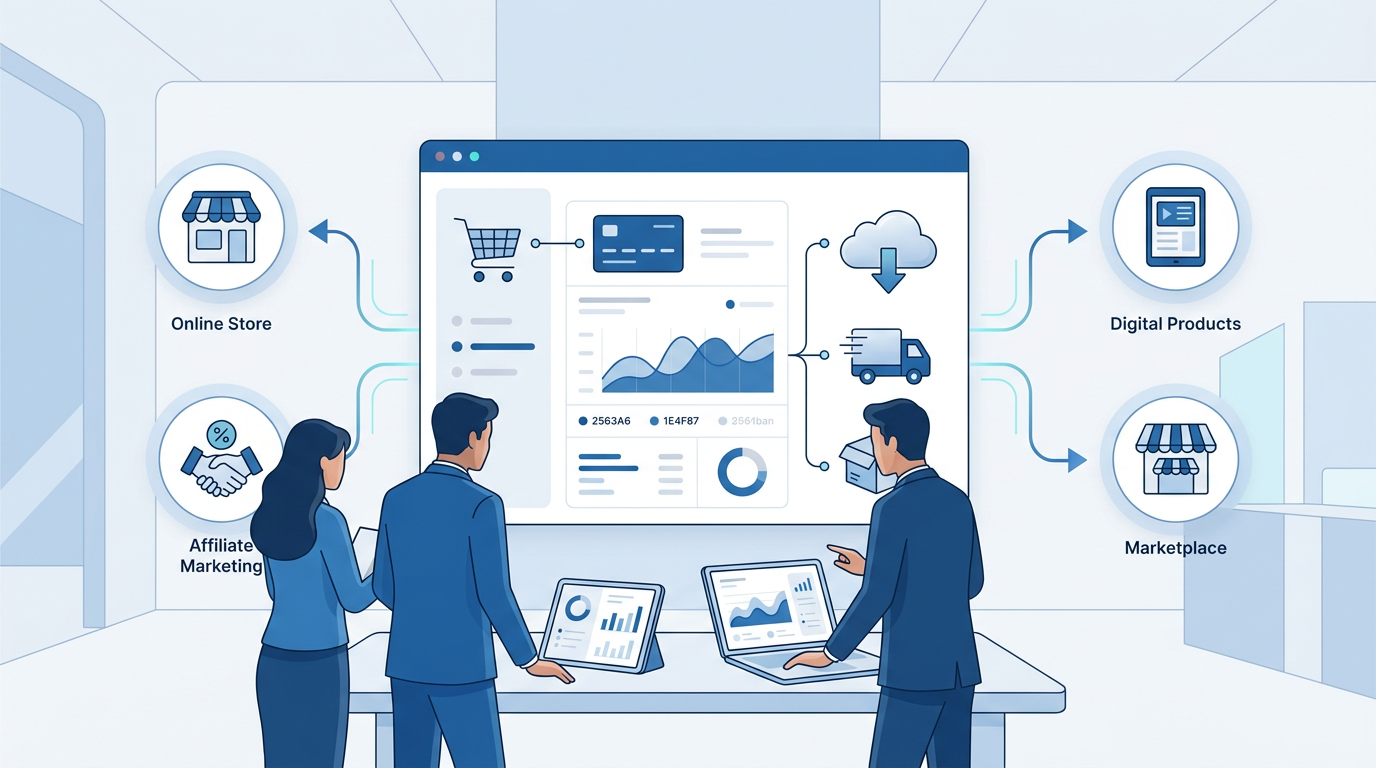
E-commerce business models explain who sells, who buys, who owns inventory, who fulfills the order and how the company earns money. Common models include inventory-led retail, direct-to-consumer sales, marketplaces, dropshipping, subscriptions and digital products. The best choice depends on margin, control, working capital, customer ownership and operational risk.
A business model is broader than a sales channel. Selling through a website, app, marketplace or social platform describes where an order is placed. It does not reveal who owns the product, who carries inventory risk, how fulfillment works or which party records the sale.
For a foundation on digital ordering and transaction flow, see our guide to e-commerce basics.
What Is an E-Commerce Business Model?
An e-commerce business model is the structure that defines how a company creates value, delivers an online order and captures revenue. It identifies the customer relationship, product source, inventory responsibility, fulfillment process, pricing authority, cost structure and revenue mechanism.
Official statistical definitions classify a transaction as e-commerce primarily by the method used to place the order. Payment and final delivery do not need to occur online. This means a digitally ordered physical product, a subscription, a downloadable file and a business order sent through an electronic ordering system can all qualify as e-commerce even though their operating models differ.
The Four Layers of an E-Commerce Model
Many articles combine customer type, fulfillment, channel and revenue into one list. That creates confusion. A clearer framework separates an e-commerce model into four layers.
| Layer | Question It Answers | Examples |
|---|---|---|
| Customer relationship | Who sells to whom? | B2C, B2B, C2C, C2B, D2C |
| Operating model | Who owns the offer and carries operational risk? | Inventory-led retail, marketplace, dropshipping, subscription, digital product |
| Sales channel | Where is the order placed? | Web store, app, marketplace, social commerce, EDI, omnichannel |
| Revenue stream | How does the business earn money? | Product margin, commission, subscription, listing fee, advertising, service fee |
A company can combine several options. A manufacturer may sell directly to consumers through its own store, sell wholesale to retailers, operate a subscription program and list excess inventory on a marketplace. The result is a hybrid model rather than one pure category.
Customer Relationship Models
Business to Consumer (B2C)
B2C e-commerce occurs when a business sells goods or services to individual consumers. The company may be a retailer, manufacturer, marketplace seller, subscription provider or digital service. B2C usually involves many smaller orders, public pricing, consumer payment methods and strong expectations around delivery, returns and support.
Business to Business (B2B)
Business to business ecommerce involves transactions between companies. Orders may include wholesale products, industrial supplies, software, professional services or recurring procurement. B2B models often use negotiated pricing, account approvals, purchase orders, credit terms, minimum quantities and electronic data interchange.
Consumer to Consumer (C2C)
C2C platforms enable individuals to sell to other individuals. The platform commonly provides listings, search, messaging, payments, trust signals or dispute processes. Revenue usually comes from commissions, listing fees, promoted placement or payment services rather than ownership of the goods.
Consumer to Business (C2B)
In a C2B arrangement, individuals provide value to businesses. Examples include creators licensing content, freelancers offering services, photographers selling media and customers contributing data or feedback under a defined commercial arrangement. A platform may match participants and collect a transaction fee.
Direct to Consumer (D2C)
D2C describes a manufacturer or brand selling directly to the end customer without relying entirely on traditional retail intermediaries. D2C is usually a form of B2C, but it highlights channel ownership and direct customer relationships.
Main E-Commerce Business Models
1. Inventory-Led Online Retail
An inventory-led retailer buys or manufactures products before selling them. The business normally controls pricing, merchandising, inventory availability and the customer promise. Revenue is recorded from product sales, while profit depends on the difference between net sales and the full cost of products and operations.
This model provides strong control but requires working capital. Unsold stock, storage, shrinkage, markdowns and obsolescence remain the retailer’s responsibility.
| Strengths | Limitations |
|---|---|
| Control over assortment, price, packaging and delivery | Cash is tied up before customer demand is confirmed |
| Potentially stronger product margin | Forecasting errors create stockouts or excess inventory |
| Clear customer ownership | Warehouse and fulfillment capability are required |
2. Direct-to-Consumer Brand
A D2C brand designs or manufactures its own products and sells through channels it controls. The economic model resembles inventory-led retail, but product differentiation and brand ownership are central.
D2C can improve gross margin by reducing traditional wholesale layers, but the brand must replace the reach and services those intermediaries provided. Customer acquisition, content, support, logistics and returns become direct costs of the model.
3. Marketplace or Platform Model
An e-commerce marketplace connects buyers with multiple independent sellers. The marketplace may provide discovery, trust, payments, fulfillment, advertising, dispute handling and other infrastructure. It usually earns a percentage of transaction value or a combination of fees.
A marketplace is not simply a large online store. The key distinction is whether the platform owns and controls the goods or mainly arranges for another party to provide them.
This distinction also affects financial reporting. A principal that controls the specified good or service before transfer generally reports the gross amount as revenue. An agent that arranges the transaction generally reports its fee or commission as revenue. Two businesses with the same customer transaction volume can therefore report very different revenue.
4. Dropshipping
Dropshipping is a retail model in which the seller accepts the customer order but a supplier stores and ships the product. The seller normally controls the storefront and customer relationship while avoiding the need to hold stock.
The model reduces inventory investment but does not remove operational responsibility. The seller may still face complaints, refunds, chargebacks, inaccurate stock feeds, shipping delays and product-quality problems. Low entry barriers also create price competition.
A useful drop shipping business model definition for ecommerce is therefore: a seller markets and sells products without physically stocking them, while a third-party supplier fulfills the order on the seller’s behalf.
5. Subscription Commerce
Subscription commerce charges customers on a recurring schedule or for an ongoing period of access. The model may involve replenishment products, curated boxes, memberships, digital services or software.
Recurring revenue can improve planning, but it should not be confused with guaranteed profit. Customer acquisition cost, churn, failed payments, fulfillment cost and unused inventory can weaken the economics. The product must provide a repeatable reason to remain subscribed.
6. Digital Products and Services
Digital commerce sells products that can be delivered electronically, such as software, templates, media, courses, licenses or online services. Marginal distribution cost may be low, but production, support, infrastructure, payment fees, licensing and customer acquisition remain real expenses.
7. On-Demand and Made-to-Order Commerce
On-demand businesses begin production or customization after the order is placed. Examples include print-on-demand products, personalized goods and made-to-measure items.
The model can reduce finished-goods inventory but may increase unit cost and delivery time. Returns are also more difficult when products are customized. Clear production timelines and approval processes are essential.
8. Hybrid and Multi-Channel Commerce
A hybrid business combines multiple operating models or channels. A retailer may own core inventory, dropship long-tail items, sell through marketplaces and operate physical stores. A software company may combine subscriptions, usage fees, services and partner commissions.
E-Commerce Revenue Streams Explained
E-commerce revenue streams describe how value becomes income. A business may use one primary stream and several supporting streams.
| Revenue Stream | How It Works | Common Users | Main Risk |
|---|---|---|---|
| Product margin | Sell products above acquisition or production cost | Retailers, wholesalers, D2C brands | Inventory, returns and price competition |
| Commission or take rate | Keep a percentage or fixed amount from each transaction | Marketplaces and platforms | Low transaction quality or seller disintermediation |
| Subscription fee | Charge periodically for access, membership or recurring delivery | Software, media, memberships and replenishment services | Churn and weak ongoing value |
| Listing fee | Charge sellers to publish or maintain offers | Classifieds and specialist marketplaces | Fees discourage supply before demand exists |
| Advertising | Sell sponsored visibility or audience access | Marketplaces, media-commerce sites and retail platforms | Commercial placement can reduce relevance and trust |
| Payment or service fee | Charge for processing, protection, delivery or another service | Platforms and transaction intermediaries | Fee complexity and regulatory obligations |
| Fulfillment and logistics | Charge for storage, packing, shipping or returns | Marketplaces and commerce infrastructure providers | High fixed cost and service-level exposure |
| Licensing | Grant rights to software, content, technology or intellectual property | Software and digital product companies | Unauthorized use and contract complexity |
Revenue Is Not the Same as Transaction Value
Gross merchandise value, gross order value and platform transaction value describe the amount processed through a commerce system. They are not necessarily accounting revenue and should not be treated as profit.
Consider a marketplace where a customer pays $100 for a seller’s product. The platform keeps a $12 commission and transfers $88 to the seller. The platform may describe $100 as transaction value, but if it acts as an agent, its revenue may be the $12 fee rather than the full order amount.
An inventory-led retailer selling its own product for $100 may report the full selling price as revenue, then separately record product and operating costs. Comparing the two companies only by reported revenue can therefore be misleading.
Unit Economics by Business Model
The best model is the one that produces acceptable contribution after all variable costs and can survive the required cash cycle.
| Model | Core Economic Question | Costs Commonly Missed |
|---|---|---|
| Inventory-led retail | Does product margin cover acquisition, fulfillment, returns and markdown risk? | Storage, damaged stock, shrinkage and unsold inventory |
| D2C brand | Does product differentiation support acquisition and operating costs? | Creative production, service, packaging and return handling |
| Marketplace | Does fee revenue exceed trust, payment, support and platform costs? | Fraud, disputes, seller acquisition and incentives |
| Dropshipping | Does the retail spread remain after advertising, refunds and supplier errors? | Chargebacks, reshipments and customer-service time |
| Subscription | Does customer lifetime contribution exceed acquisition and retention cost? | Churn, failed payments, pauses and unused inventory |
| Digital product | Does scalable delivery offset creation, support and platform cost? | Updates, refunds, infrastructure and piracy |
Marketing decisions must match these economics. Our guide to marketing channels explains why revenue growth can still destroy value when acquisition, returns and fulfillment consume the available margin.
How to Choose an E-Commerce Business Model
Step 1: Define the Value You Control
Identify whether the business controls a differentiated product, a customer audience, a supplier network, a fulfillment capability, software, data or trusted transaction infrastructure. The strongest model usually monetizes an asset the company can defend.
Step 2: Decide Which Risks You Can Carry
Inventory-led models carry stock and fulfillment risk. Marketplaces carry trust, liquidity and platform risk. Dropshippers carry supplier-dependence and customer-experience risk. Subscription businesses carry churn risk. Digital products carry content, support and intellectual-property risk.
Step 3: Calculate the Cash Cycle
Determine when suppliers must be paid, when customers pay, how long delivery takes and when returns settle. A profitable model can fail if cash leaves months before revenue becomes available.
Step 4: Evaluate Customer Ownership
Owned channels generally provide more control over customer data and experience. Marketplaces provide access to demand but can limit customer communication and make the business dependent on platform policies.
Step 5: Test the Smallest Viable Version
A company does not need a full warehouse, national marketplace or complex subscription platform to test demand. It can begin with a narrow assortment, one customer group, limited geography or manual operations. The test should measure contribution and operational failure, not only orders.
Step 6: Add Technology After the Process Is Clear
Automation can improve forecasting, search, support and fraud review, but it should not hide an unclear commercial structure. Our guide to AI tools explains how to select low-risk applications after data and process ownership are established.
Decision Framework
| Business Condition | Best Starting Model | Reason |
|---|---|---|
| You control a differentiated physical product | D2C or inventory-led retail | Control supports pricing, brand and customer experience |
| You have demand but limited inventory capital | Carefully selected dropshipping or made-to-order | Reduces stock investment while testing demand |
| You can attract both buyers and sellers | Marketplace | Network participation can become the core asset |
| The customer need repeats predictably | Subscription or replenishment model | Recurring demand may support repeat revenue |
| The product can be delivered digitally | Digital product, license or subscription | Delivery scales without physical fulfillment |
| You already operate stores or wholesale channels | Hybrid or multi-channel model | Digital ordering can extend existing assets |
Practical Example: Three Businesses Selling the Same Product
Imagine three businesses selling a $100 desk lamp.
Inventory-Led Retailer
The retailer buys the lamp for $45, stores it and sells it for $100. It controls the product page and delivery promise. After payment fees, marketing, warehouse work, shipping subsidy and expected returns, it calculates the remaining contribution.
Dropshipping Store
The dropshipping store sells the same lamp for $100 and pays a supplier $68 to ship it. It avoids warehouse investment but has less control over stock accuracy, packaging and delivery. A supplier error can consume the entire order margin.
Marketplace
The marketplace does not own the lamp. A seller lists it for $100, and the platform keeps a 12% commission. The platform earns $12 before payment, support, fraud and infrastructure costs. Its challenge is attracting enough reliable buyers and sellers to create liquidity.
All three participate in e-commerce, but their revenue, risk, working capital and operational responsibilities are different. This is why a channel label alone cannot explain a business model.
Common Business Model Failures
| Failure | Warning Sign | Why It Happens | Better Response |
|---|---|---|---|
| Confusing revenue with profit | Orders grow while cash declines | Reports exclude returns, fulfillment and acquisition costs | Track contribution by product, channel and customer type |
| Calling every platform a marketplace | The company cannot explain who owns inventory or sets price | Interface design is mistaken for operating structure | Document principal, agent and fulfillment responsibilities |
| Scaling before supplier reliability is proven | Cancellations and support tickets rise with sales | Demand grows faster than operational control | Test stock feeds, lead times and exception handling first |
| Launching a subscription without recurring value | Customers cancel after the first billing cycle | Recurring payment is treated as a substitute for product fit | Match frequency to a genuine repeat need |
| Overdependence on one marketplace | A policy or ranking change threatens most revenue | The business rents demand but does not build owned access | Develop direct customer relationships and alternative channels |
| Ignoring legal and tax role | Seller, platform and customer records disagree | Commercial responsibility is not documented | Review contracts, invoicing, tax and consumer obligations by market |
| Building too many revenue streams | Customers cannot understand pricing | Every possible fee is added without a clear value exchange | Use one primary stream and add only supportive fees |
Marketplace Responsibility Can Change by Jurisdiction
A platform may act as an intermediary commercially but receive additional tax or consumer obligations under local law. For example, certain marketplace transactions in the European Union can cause the electronic interface to be treated as a deemed supplier for VAT purposes.
Frequently Asked Questions
What are the main types of e-commerce business models?
The main models are inventory-led retail, direct-to-consumer brands, marketplaces, dropshipping, subscriptions, digital products, on-demand production and hybrid commerce. Each model differs in inventory ownership, customer control, fulfillment responsibility, cost structure and method of earning revenue.
What is the most profitable e-commerce business model?
No model is automatically the most profitable. Profitability depends on product margin, customer acquisition, returns, fulfillment, working capital, competition and customer retention. A digital product may have low delivery cost but high acquisition and support cost, while physical retail may have stronger demand but greater inventory risk.
What is the difference between a marketplace and an online retailer?
An online retailer normally buys or controls the goods sold to customers and earns product margin. A marketplace mainly connects independent buyers and sellers and earns commissions or service fees. Some companies operate both models, so the role must be assessed transaction by transaction.
How does a dropshipping business make money?
A dropshipping business earns the difference between the customer’s selling price and the supplier’s product and shipping charge. True contribution must also subtract marketing, payment fees, refunds, chargebacks, support and reshipments. Avoiding inventory does not guarantee a healthy margin.
What are common e-commerce revenue streams?
Common revenue streams include product margin, commissions, subscriptions, listing fees, advertising, payment fees, fulfillment services, licensing and other transaction services. The strongest model normally has one clear primary stream supported by additional services that customers or sellers genuinely value.
Can one company use several e-commerce models?
Yes. A company can sell owned inventory, host third-party sellers, offer subscriptions and operate physical stores. Hybrid models can diversify revenue, but they require clear product ownership, pricing, inventory, tax, returns and financial reporting across each transaction type.
Is B2B e-commerce different from B2C e-commerce?
B2B e-commerce usually involves company accounts, negotiated prices, larger orders, purchase approvals, credit terms and repeat procurement. B2C commonly uses public pricing and consumer checkout. Both qualify as e-commerce when orders are placed through digital systems designed to receive them.
How should a small business choose a model?
A small business should choose the model that matches its strongest asset and manageable risk. Start with product control, customer access, supplier reliability, available capital and operational capability. Test a narrow version, measure contribution after all variable costs and expand only when failures remain controlled.
Final Summary
E-commerce business models determine more than where a product is sold. They define the relationship between buyer and seller, ownership of inventory, responsibility for fulfillment, control of the customer experience and the way revenue is earned.
The most useful analysis separates four layers: customer relationship, operating model, sales channel and revenue stream. This prevents common mistakes such as confusing marketplace transaction value with revenue or treating dropshipping as a risk-free retail model.
The best model is not the one with the lowest apparent cost or the fastest launch. It is the one whose margin, cash cycle, customer ownership and operational responsibilities fit the company’s real capabilities.