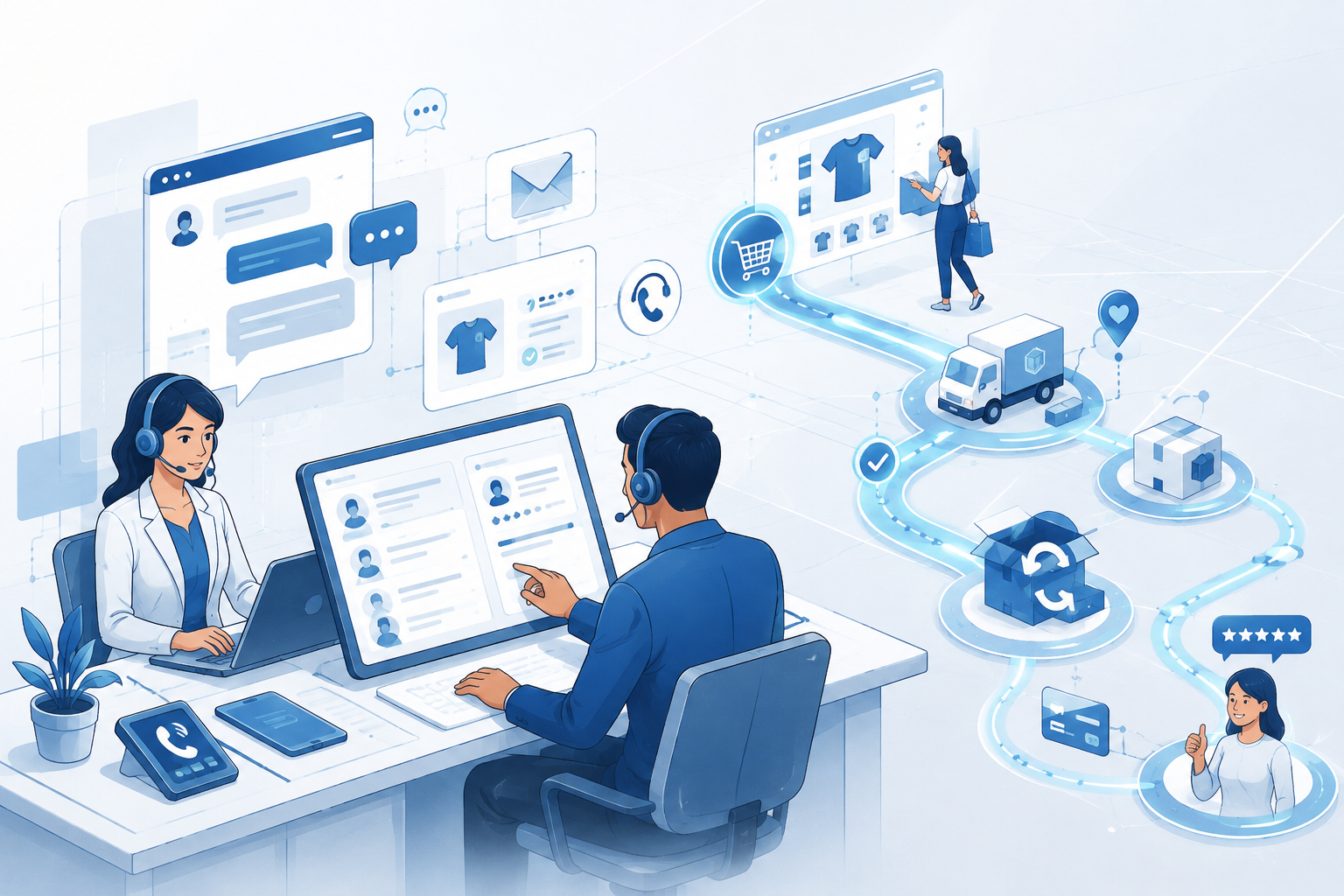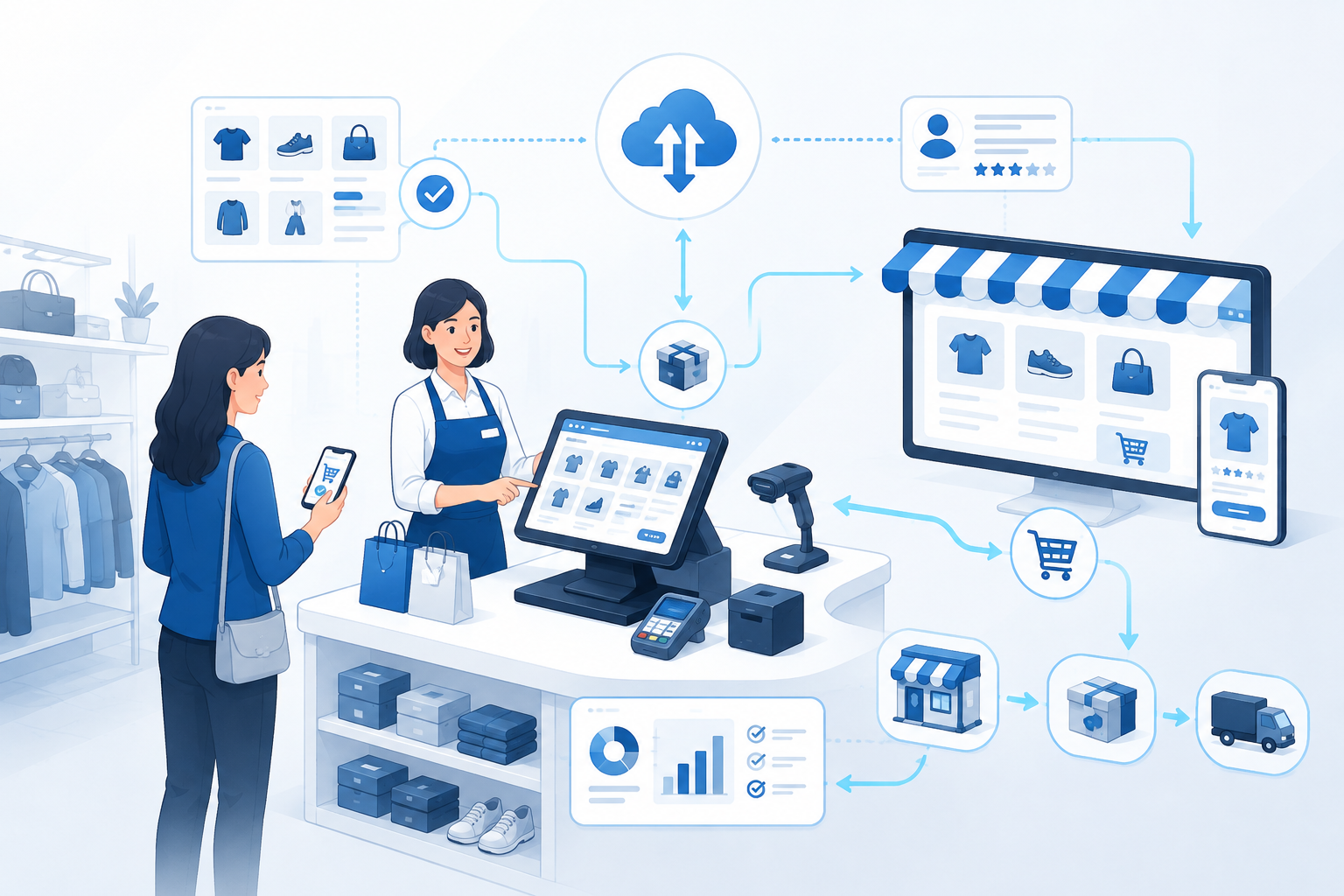
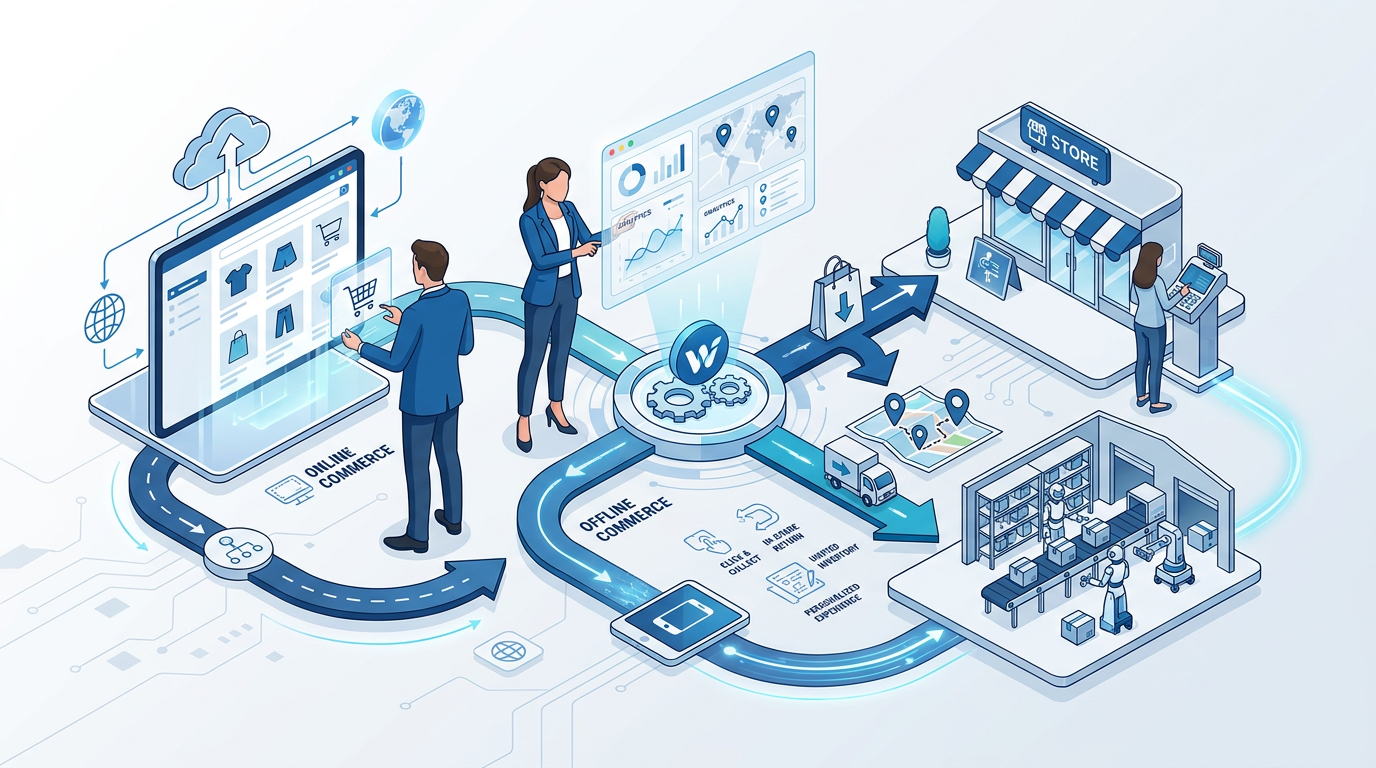
E-commerce in retail connects digital ordering with physical stores, inventory, payments, fulfillment and customer service. Omnichannel retail coordinates these touchpoints as one operating system, while online-to-offline commerce uses digital discovery or ordering to produce a store visit, pickup, local service or another physical interaction.
Retail e-commerce is no longer limited to shipping parcels from a distant warehouse. A customer may research a product on a phone, inspect it in a store, order through an app, collect it at a local branch and return it through a different location. The transaction crosses channels, but the customer expects one consistent retailer.
The scale of digital shopping makes this integration commercially important. In the first quarter of 2026, e-commerce represented 16.9% of total U.S. retail sales. In the European Union, 78% of internet users bought or ordered goods or services online in 2025. Digital orders remain a minority of total retail sales in many markets, but digital research, comparison and service influence a much larger share of purchasing decisions.
Readers who need the basic transaction definition can first review how digital ordering works.
What Is E-Commerce in Retail?
E-commerce in retail is the sale of goods or services through an ordering method designed for digital networks, combined with the operational processes required to price, fulfill, support and account for the transaction. The product may be delivered to a home, collected from a store, transferred digitally or supplied through another physical location.
The order method determines whether a transaction is classified as e-commerce. A customer can place an online order and pay in a store, or place an online order for physical pickup. The transaction remains digitally ordered even though payment or fulfillment occurs offline.
This distinction prevents a common mistake: online retail is not defined only by home delivery. Click and collect, reserve online and pay in store, ship from store, curbside pickup and digitally booked retail services can all connect e-commerce with a physical location.
Online Retail, Multichannel, Omnichannel and O2O
| Model | How It Works | Customer Experience | Operational Requirement |
|---|---|---|---|
| Online-only retail | Orders are placed digitally and fulfilled without a customer-facing store | Digital journey with delivery or digital fulfillment | Website, payments, inventory, warehouse and delivery |
| Multichannel retail | The retailer sells through several channels that may operate separately | Customers can choose a channel, but data and policies may differ | Channel-specific systems and teams |
| Omnichannel retail | Channels share inventory, identity, orders, policies and service processes | The customer can move between channels with continuity | Integrated data, order management and operational ownership |
| Online-to-offline commerce | Digital activity leads to a physical visit, pickup, appointment or local transaction | Online convenience combined with physical access | Accurate local data, store execution and attribution |
| Offline-to-online retail | A store interaction leads to a later digital order or relationship | Customers continue the journey after leaving the store | Customer identification, consent and connected product data |
Multichannel retail provides several ways to buy. Omnichannel retail connects those ways. A retailer can operate a website, an app and physical stores without being omnichannel when each channel has separate inventory, promotions, customer records and return rules.
What Is Online-to-Offline Commerce?
Online-to-offline commerce, often shortened to O2O, uses a digital interaction to initiate or support a physical retail action. The digital stage may include search, advertising, inventory checking, booking, ordering or payment. The offline stage may include pickup, product inspection, installation, service or an in-store purchase.
Common online-to-offline retail journeys include:
- buy online and pick up in store;
- reserve online and pay at pickup;
- check local inventory before visiting;
- book a fitting, consultation or repair online;
- order restaurant or grocery products for local collection;
- use a digital coupon inside a store;
- scan a store display and complete the order online;
- return an online order to a physical location.
Why Retailers Combine Digital and Physical Channels
Customers Use Channels for Different Jobs
Digital channels are strong at search, comparison, availability checking and repeated ordering. Physical stores are strong at immediate possession, product inspection, fitting, advice and local problem resolution. A combined model allows each channel to perform the job it handles best.
Stores Can Become Fulfillment Assets
A store can serve as a pickup point, return point, local delivery node or ship-from-store location. This flexibility can reduce delivery distance and use stock that would otherwise remain isolated in one branch.
The operational benefit is not automatic. Store fulfillment adds picking, staging, packaging and handoff work to a location originally designed for customer browsing. UNCTAD has noted that omnichannel operations can require substantially more logistics space than traditional retail because inventory must support unit picking, returns and multiple fulfillment paths.
The Omnichannel Retail Operating System
Omnichannel retail depends on connected operating capabilities rather than a visible website feature. The following components form the practical system.
Commerce Platform
The commerce platform presents products, prices, promotions, account functions and checkout. The platform should receive dependable information from product, inventory, tax, payment and fulfillment systems instead of becoming an isolated source of truth.
Product Information Management
A product information management process maintains titles, descriptions, dimensions, images, compatibility, materials and other attributes. Consistent data helps customers identify the same item online and in a store.
Point-of-Sale System
The point-of-sale system records store transactions and may support pickup, returns, customer identification and endless-aisle orders. A disconnected POS can create inventory delays and prevent staff from viewing online orders.
Order Management System
An order management system coordinates the order after checkout. The system can determine which warehouse or store should fulfill the order, reserve inventory, split shipments, manage cancellations and update status across channels.
Inventory Visibility
Inventory visibility estimates what can actually be promised at each location. Physical stock, reserved units, damaged items, safety stock and pending transfers all affect availability.
A retailer should not display every recorded unit as sellable. When a system promises the final unit in a busy store, the item may already be in another customer’s basket, misplaced or awaiting a stock adjustment. An availability buffer can protect the pickup promise.
Forecasting and routing systems can support these decisions, but automation depends on reliable source data. Our guide to AI tools explains how to introduce lower-risk applications without automating bad inventory records.
Customer Data and Identity
Connected identity allows the retailer to recognize a customer across a store account, website, app and service interaction when lawful and consented. The goal is operational continuity, not unlimited tracking.
Customer Service Platform
Support employees need access to order status, payment events, fulfillment, returns and prior communication. A unified interface reduces the need to transfer customers between channel-specific teams.
| Capability | Customer Promise | Failure When Disconnected |
|---|---|---|
| Inventory visibility | The displayed product is available | Cancelled pickups and wasted store visits |
| Order management | The order follows the best fulfillment path | Late orders, split shipments and manual intervention |
| Customer identity | Accounts, loyalty and service history remain consistent | Duplicate profiles and missing benefits |
| Pricing and promotion | Eligibility and conditions are understandable | Conflicting prices and checkout disputes |
| Returns management | The customer can use the promised return route | Store refusals and refund delays |
Key Omnichannel Fulfillment Methods
Buy Online, Pick Up in Store
Buy online, pick up in store allows the customer to complete the order digitally and collect it from a location. The retailer must reserve the item, confirm that staff physically found it, prepare it and communicate when collection is ready.
A confirmation of payment should not be treated as a pickup-ready message. The order becomes ready only after the store verifies and stages the product.
Reserve Online, Pay in Store
A reservation holds an item without completing the sale. This method reduces payment complexity but creates no-show risk. The retailer needs an expiration period and a rule for returning uncollected stock to availability.
Ship From Store
Ship from store uses branch inventory to fulfill a delivery order. The method can improve local availability and use slow-moving stock, but store layouts and staffing may not support efficient parcel picking.
Inventory Accuracy Is the Core Omnichannel Constraint
Omnichannel promises depend on inventory accuracy. A sophisticated interface cannot compensate for unreliable location-level stock.
The main causes of inventory mismatch include:
- delayed sales and return updates;
- items placed in the wrong location;
- damage, theft and shrinkage;
- unprocessed deliveries or transfers;
- online reservations not reflected in store systems;
- incorrect variant or barcode records;
- manual adjustments without documented reasons.
A practical inventory policy separates recorded stock from available-to-promise stock. The retailer subtracts reservations, safety buffers and known exceptions before offering a unit online.
Returns Are a Separate Omnichannel Journey
Retailers often design the purchase journey before designing reverse logistics. However, returns require their own routing, inventory and refund decisions.
An online order returned to a store can be:
- restocked locally;
- sent to a central warehouse;
- returned to a supplier;
- refurbished or repaired;
- marked down;
- recycled or disposed of.
The correct path depends on product condition, local demand, packaging and supplier agreements. Returning every item to a central warehouse may waste transport, while restocking unsuitable goods locally can create inaccurate availability.
Customer experience remains a major issue in online retail. Eurostat reported that 35.4% of EU online shoppers encountered a problem with a website or app purchase in 2025. Delivery performance, difficult interfaces and inaccurate information were among the areas that can undermine trust. Omnichannel expansion should reduce these failures rather than create additional handoffs.
How Marketing Changes in Omnichannel Retail
Omnichannel marketing coordinates messages with local availability, customer intent and the chosen fulfillment path. A campaign should not promote store pickup when the nearby location cannot fulfill the advertised product.
The retailer should assign each channel a role. Local search can capture store intent. Social content can demonstrate products. Email can remind customers about an uncollected order. Store signage can move customers to digital product details or extended inventory.
Our guide to marketing channels explains why campaign performance should be evaluated using contribution and customer value rather than attributed revenue alone.
Measuring Online-to-Offline Performance
Online-to-offline measurement is difficult because the digital touchpoint and physical transaction may use different identifiers. A customer can research anonymously, visit a store with another device and pay without using a loyalty account.
| Metric | What It Shows | Important Limitation |
|---|---|---|
| Pickup adoption rate | Share of eligible digital orders collected from stores | High adoption may reflect delivery fees rather than preference |
| Pickup ready time | Time from order acceptance to collection readiness | Average time can hide store-level failures |
| Pickup cancellation rate | Orders cancelled because stock could not be found or fulfilled | Needs reason-level classification |
| Store-assisted digital sales | Orders placed with help from store staff | Attribution depends on employee and order tracking |
| Cross-channel return rate | Online orders returned through a store or another channel | High usage can mean convenience or product-quality problems |
| Inventory accuracy | Difference between system stock and verified physical stock | Cycle-count method affects the result |
| Incremental store sales | Additional purchases associated with pickup visits | Basket attachment does not prove the pickup caused the sale |
Retailers should distinguish recorded attribution from causal impact. A digital advertisement may receive credit for a store purchase, but the customer may have visited anyway. Matched-market tests, store pilots and controlled rollouts provide stronger evidence than dashboard attribution alone.
Practical Example: A Regional Fashion Retailer
Consider a fashion retailer with 18 stores and one online shop. The company wants to introduce click and collect because customers frequently ask whether items are available locally.
Phase 1: Inventory Validation
The retailer maps product variants across the POS, warehouse and commerce platform. Stores begin frequent cycle counts for high-demand categories. The company creates a two-unit safety buffer for locations with weaker accuracy.
Phase 2: Limited Pickup Pilot
Three stores offer pickup for selected categories. The website shows an estimated collection time but does not promise immediate availability. Employees must scan the item before the customer receives a ready notification.
Phase 3: Returns and Service
The retailer documents which online products can be restocked in a branch and which must return to the warehouse. Store employees receive access to order history and refund status.
Phase 4: Expanded Fulfillment
After inventory accuracy and pickup cancellation rates reach acceptable levels, the retailer adds ship from store for selected locations. The company does not activate every store at once because staffing and storage space differ.
This phased model treats omnichannel retail as an operating change rather than a website feature. The retailer proves each process before advertising it widely.
Common Omnichannel Retail Failures
| Failure | Warning Sign | Underlying Cause | Better Approach |
|---|---|---|---|
| Launching pickup with inaccurate stock | Frequent “item not found” cancellations | Recorded inventory is treated as available inventory | Use verification, buffers and store-level accuracy targets |
| Adding fulfillment work without labor planning | Orders wait while employees serve store customers | Pickup and packing are treated as free tasks | Measure workload and schedule responsibility by daypart |
| Separate return policies by channel | Stores refuse valid online returns | Systems and employee procedures are disconnected | Create one eligibility engine and clear exceptions |
| Promoting unavailable local products | Ads generate visits but not completed purchases | Marketing feeds ignore location inventory | Connect campaign eligibility to available-to-promise data |
| Measuring only total sales | Revenue rises while fulfillment cost and cancellations increase | Channel growth is not linked to contribution | Track net margin, workload, returns and failed promises |
| Using one process for every store | Small locations become congested | Store capacity differences are ignored | Set services and order limits by location capability |
| Collecting data without a service purpose | Customer profiles expand but operations do not improve | Identity resolution becomes the objective | Collect only data needed for continuity, consented marketing or service |
How to Build an Omnichannel Roadmap
1. Map the Current Customer Journey
Document where customers search, compare, purchase, collect, request support and return products. Record every system and team involved in each transition.
2. Choose One Customer Promise
Begin with a narrow promise such as accurate local availability or pickup from selected stores. A specific promise creates measurable operational requirements.
3. Define the Source of Truth
Assign authoritative systems for product, price, inventory, order and customer data. Integration becomes unstable when several applications can overwrite the same record without clear priority.
4. Pilot by Location and Category
Select stores with reliable staffing, inventory and management. Use categories that are easy to identify and handle. Measure failures before adding more locations.
5. Train for Exceptions
Employees need procedures for missing items, damaged products, late collections, partial orders, identity checks, refund failures and system outages.
6. Measure Contribution, Not Channel Credit
Include picking labor, packaging, delivery, returns and additional technology cost. Omnichannel volume is useful only when the service supports profit, retention or a clearly defined strategic objective.
7. Expand Only After the Promise Is Reliable
Marketing should scale after stores consistently meet readiness, accuracy and service targets. Advertising an unreliable service increases demand for the exact process that is failing.
How the Retail Model Affects Omnichannel Strategy
Inventory ownership and fulfillment responsibility determine which omnichannel promises are realistic. An inventory-led retailer can allocate owned stock, while marketplaces and dropshipping businesses depend more heavily on third parties. Our comparison of business models explains these structural differences.
Frequently Asked Questions
What is e-commerce in retail?
E-commerce in retail is the use of digital ordering systems to sell retail goods or services. The order may be delivered, collected from a store or fulfilled through another channel. Retail e-commerce also includes the inventory, payment, service, returns and accounting processes needed to complete the transaction.
What is omnichannel retail?
Omnichannel retail connects stores, websites, apps, inventory, orders, customer identity and service policies so customers can move between channels with continuity. A retailer is not truly omnichannel merely because it operates several channels; the channels must share dependable data and coordinated processes.
What is the difference between multichannel and omnichannel retail?
Multichannel retail offers several sales or communication channels. Omnichannel retail integrates those channels around shared inventory, customer records, orders and policies. A multichannel customer may need to restart the process when changing channels, while an omnichannel customer can continue the same journey.
What is online-to-offline retail?
Online-to-offline retail uses digital discovery, ordering or booking to produce a physical interaction. Examples include click and collect, local inventory checks, appointment booking, digital coupons and online returns to a store. The model connects digital convenience with store access or local service.
What does buy online, pick up in store mean?
Buy online, pick up in store means the customer completes a digital order and collects it from a physical location. The retailer must reserve, verify and stage the item before sending a ready notification. A payment confirmation alone does not prove that the item is ready.
What technology is needed for omnichannel retail?
Omnichannel retail commonly requires a commerce platform, point-of-sale system, product information, order management, inventory visibility, customer service and payment integration. The exact software is less important than clear data ownership, timely updates and reliable exception handling across each channel.
What is the biggest challenge in omnichannel retail?
Inventory accuracy is often the biggest operational challenge because pickup, local delivery and ship-from-store promises depend on location-level stock. Recorded stock can differ from physical stock because of shrinkage, misplaced items, delayed updates, reservations, damage and unprocessed returns.
Are physical stores still important in e-commerce?
Physical stores can support e-commerce as pickup points, return locations, local fulfillment nodes, showrooms and service centers. The value depends on store capacity and operational design. A store becomes an effective digital asset only when inventory, orders, staffing and customer communication are coordinated.
Final Summary
E-commerce in retail is the integration of digital ordering with the physical and operational parts of retail. Omnichannel retail coordinates channels as one system, while online-to-offline commerce connects digital interactions with store visits, pickup, local service or physical fulfillment.
The most important success factor is not the number of channels. The most important success factor is whether the retailer can keep the customer promise across inventory, pricing, orders, fulfillment, returns and service.
A practical roadmap begins with one narrow promise, accurate source data, a controlled store pilot and clear failure procedures. Retailers should expand only after the process consistently works and produces acceptable contribution after labor, logistics, returns and technology costs.